Question ID: #394
Let the position vectors of three vertices of a triangle be $4\vec{p}+\vec{q}-3\vec{r}$, $-5\vec{p}+\vec{q}+2\vec{r}$ and $2\vec{p}-\vec{q}+2\vec{r}$. If the position vectors of the orthocenter and the circumcenter of the triangle are $\frac{\vec{p}+\vec{q}+\vec{r}}{4}$ and $\alpha\vec{p}+\beta\vec{q}+\gamma\vec{r}$ respectively, then $\alpha+2\beta+5\gamma$ is equal to:
- (1) 3
- (2) 1
- (3) 6
- (4) 4
Solution:
First, we determine the Centroid ($G$) of the triangle by averaging the position vectors of the vertices:
$$ \vec{G} = \frac{(4\vec{p}+\vec{q}-3\vec{r}) + (-5\vec{p}+\vec{q}+2\vec{r}) + (2\vec{p}-\vec{q}+2\vec{r})}{3} $$
$$ \vec{G} = \frac{(4-5+2)\vec{p} + (1+1-1)\vec{q} + (-3+2+2)\vec{r}}{3} = \frac{\vec{p}+\vec{q}+\vec{r}}{3} $$
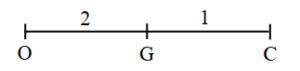
The Orthocenter ($H$) is given as $H = \frac{\vec{p}+\vec{q}+\vec{r}}{4}$.
Using the property that the Centroid ($G$) divides the line segment joining the Orthocenter ($H$) and Circumcenter ($O$) in the ratio $2:1$, we have the relation:
$$ \vec{G} = \frac{\vec{H} + 2\vec{O}}{3} \Rightarrow 3\vec{G} = \vec{H} + 2\vec{O} $$
Substituting the vectors $\vec{G}$ and $\vec{H}$:
$$ 3\left(\frac{\vec{p}+\vec{q}+\vec{r}}{3}\right) = \frac{\vec{p}+\vec{q}+\vec{r}}{4} + 2\vec{O} $$
$$ \vec{p}+\vec{q}+\vec{r} – \frac{1}{4}(\vec{p}+\vec{q}+\vec{r}) = 2\vec{O} $$
$$ \frac{3}{4}(\vec{p}+\vec{q}+\vec{r}) = 2\vec{O} \Rightarrow \vec{O} = \frac{3}{8}\vec{p} + \frac{3}{8}\vec{q} + \frac{3}{8}\vec{r} $$
Comparing this with the given form $\vec{O} = \alpha\vec{p}+\beta\vec{q}+\gamma\vec{r}$, we get $\alpha = \frac{3}{8}, \beta = \frac{3}{8}, \gamma = \frac{3}{8}$.
Finally, calculating the required expression:
$$ \alpha+2\beta+5\gamma = \frac{3}{8} + 2\left(\frac{3}{8}\right) + 5\left(\frac{3}{8}\right) = \frac{3+6+15}{8} = \frac{24}{8} = 3 $$
Ans. (1)
Was this solution helpful?
YesNo