Let a line passing through the point $(4, 1, 0)$ intersect the line $L_1: \frac{x-1}{2} = \frac{y-2}{3} = \frac{z-3}{4}$ at the point $A(\alpha, \beta, \gamma)$ and the line $L_2: x-6 = y = -z+4$ at the point $B(a, b, c)$.
Then $\begin{vmatrix} 1 & 0 & 1 \\ \alpha & \beta & \gamma \\ a & b & c \end{vmatrix}$ is equal to
- (1) $8$
- (2) $16$
- (3) $12$
- (4) $6$
Solution:
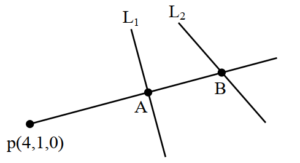
$$L_1 : \frac{x-1}{2} = \frac{y-2}{3} = \frac{z-3}{4} = p$$
$$A(\alpha, \beta, \gamma) \equiv (2p+1, 3p+2, 4p+3)$$
$$L_2 : \frac{x-6}{1} = \frac{y}{1} = \frac{z-4}{-1} = q$$
$$B(a, b, c) \equiv (q+6, q, 4-q)$$
Direction ratios of the line passing through $P(4, 1, 0)$ and $A$:
$$D.R._{PA} = (2p-3, 3p+1, 4p+3)$$
Direction ratios of the line passing through $P(4, 1, 0)$ and $B$:
$$D.R._{PB} = (q+2, q-1, 4-q)$$
Points $P$, $A$, and $B$ are collinear, so their direction ratios are proportional:
$$\frac{2p-3}{q+2} = \frac{3p+1}{q-1} = \frac{4p+3}{4-q}$$
$$\frac{2p-3}{q+2} = \frac{4p+3}{4-q}$$
$$(2p-3)(4-q) = (4p+3)(q+2)$$
$$8p – 2pq – 12 + 3q = 4pq + 8p + 3q + 6$$
$$-6pq = 18 \Rightarrow pq = -3$$
$$\frac{2p-3}{q+2} = \frac{3p+1}{q-1}$$
$$(2p-3)(q-1) = (3p+1)(q+2)$$
$$2pq – 2p – 3q + 3 = 3pq + 6p + q + 2$$
$$pq + 8p + 4q – 1 = 0$$
Substitute $pq = -3$:
$$-3 + 8p + 4q – 1 = 0 \Rightarrow 2p + q = 1$$
$$\frac{3p+1}{q-1} = \frac{4p+3}{4-q}$$
$$(3p+1)(4-q) = (4p+3)(q-1)$$
$$12p – 3pq + 4 – q = 4pq – 4p + 3q – 3$$
$$7pq – 16p + 4q – 7 = 0$$
Substitute $pq = -3$:
$$7(-3) – 16p + 4q – 7 = 0 \Rightarrow 4p – q = -7$$
$$2p + q = 1$$
$$4p – q = -7$$
$$6p = -6 \Rightarrow p = -1$$
$$q = 3$$
$$A(\alpha, \beta, \gamma) \equiv (-2+1, -3+2, -4+3) \equiv (-1, -1, -1)$$
$$B(a, b, c) \equiv (3+6, 3, 4-3) \equiv (9, 3, 1)$$
$$\begin{vmatrix} 1 & 0 & 1 \\ \alpha & \beta & \gamma \\ a & b & c \end{vmatrix} = \begin{vmatrix} 1 & 0 & 1 \\ -1 & -1 & -1 \\ 9 & 3 & 1 \end{vmatrix}$$
$R_1 \rightarrow R_1 + R_2$
$$= \begin{vmatrix} 0 & -1 & 0 \\ -1 & -1 & -1 \\ 9 & 3 & 1 \end{vmatrix}$$
$$= -(-1) \begin{vmatrix} -1 & -1 \\ 9 & 1 \end{vmatrix}$$
$$= 1(-1 + 9) = 8$$
Ans. (1)