Question ID: #306
A rod of length eight units moves such that its ends A and B always lie on the lines $x-y+2=0$ and $y+2=0$, respectively. If the locus of the point P, that divides the rod AB internally in the ratio 2:1 is $9(x^{2}+\alpha y^{2}+\beta xy+\gamma x+28y)-76=0$ then $\alpha-\beta-\gamma$ is equal to:
- (1) 24
- (2) 23
- (3) 21
- (4) 22
Solution:
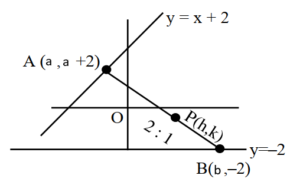
Let the coordinates of end A be on the line $x – y + 2 = 0$.
So, $y = x + 2$. Let $A = (a, a+2)$.
Let the coordinates of end B be on the line $y + 2 = 0$.
So, $y = -2$. Let $B = (b, -2)$.
The length of the rod is given as 8.
$$AB^2 = (a-b)^2 + (a+2 – (-2))^2 = 64$$
$$(a-b)^2 + (a+4)^2 = 64 \quad \dots(1)$$
Let $P(h, k)$ be the point dividing AB internally in the ratio $2:1$.
Using the section formula:
$$h = \frac{1(a) + 2(b)}{1+2} = \frac{a+2b}{3} \Rightarrow 3h = a+2b \quad \dots(2)$$
$$k = \frac{1(a+2) + 2(-2)}{1+2} = \frac{a+2-4}{3} = \frac{a-2}{3} \Rightarrow 3k = a-2 \Rightarrow a = 3k+2 \quad \dots(3)$$
From (3), we have the value of $a$. Substitute this into (2) to find $b$:
$$3h = (3k+2) + 2b$$
$$2b = 3h – 3k – 2 \Rightarrow b = \frac{3h – 3k – 2}{2}$$
Now substitute $a$ and $b$ back into equation (1):
Term $(a+4)^2$:
$$(3k+2+4)^2 = (3k+6)^2 = 9(k+2)^2$$
Term $(a-b)^2$:
$$a-b = (3k+2) – \frac{3h-3k-2}{2} = \frac{6k+4 – 3h + 3k + 2}{2} = \frac{9k – 3h + 6}{2} = \frac{3}{2}(3k – h + 2)$$
So, $(a-b)^2 = \frac{9}{4}(3k – h + 2)^2$.
Equation (1) becomes:
$$\frac{9}{4}(3k – h + 2)^2 + 9(k+2)^2 = 64$$
Multiply by 4/9:
$$(3k – h + 2)^2 + 4(k+2)^2 = \frac{256}{9}$$
Expand the terms (replace $h$ with $x$ and $k$ with $y$):
$$(3y – x + 2)^2 + 4(y+2)^2 = \frac{256}{9}$$
$$[9y^2 + x^2 + 4 – 6xy + 12y – 4x] + 4[y^2 + 4y + 4] = \frac{256}{9}$$
$$9y^2 + x^2 + 4 – 6xy + 12y – 4x + 4y^2 + 16y + 16 = \frac{256}{9}$$
$$x^2 + 13y^2 – 6xy – 4x + 28y + 20 = \frac{256}{9}$$
Multiply by 9:
$$9(x^2 + 13y^2 – 6xy – 4x + 28y) + 180 = 256$$
$$9(x^2 + 13y^2 – 6xy – 4x + 28y) – 76 = 0$$
Comparing with the given equation $9(x^{2}+\alpha y^{2}+\beta xy+\gamma x+28y)-76=0$:
$\alpha = 13$
$\beta = -6$
$\gamma = -4$
We need to find $\alpha – \beta – \gamma$:
$$\alpha – \beta – \gamma = 13 – (-6) – (-4)$$
$$= 13 + 6 + 4 = 23$$
Ans. (23)
Was this solution helpful?
YesNo