Let the line $x+y=1$ meet the axes of $x$ and $y$ at $A$ and $B$, respectively. A right angled triangle $AMN$ is inscribed in the triangle $OAB$, where $O$ is the origin and the points $M$ and $N$ lie on the lines $OB$ and $AB$, respectively. If the area of the triangle $AMN$ is $\frac{4}{9}$ of the area of the triangle $OAB$ and $\frac{AN}{NB} = \frac{\lambda}{1}$, then the sum of all possible value(s) of $\lambda$ is:
- (1) $\frac{1}{2}$
- (2) $\frac{13}{6}$
- (3) $\frac{5}{2}$
- (4) 2
Solution:
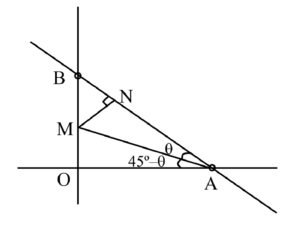
The vertices of the triangle are $O(0,0)$, $A(1,0)$, and $B(0,1)$. The area of $\Delta OAB$ is:
$$ \text{Area}(OAB) = \frac{1}{2} \times 1 \times 1 = \frac{1}{2} $$
We are given that $\text{Area}(AMN) = \frac{4}{9} \times \text{Area}(OAB) = \frac{4}{9} \times \frac{1}{2} = \frac{2}{9}$.
Let $\angle MAN = \theta$. Since $\Delta OAB$ is an isosceles right-angled triangle, $\angle OAB = 45^\circ$, which implies $\angle OAM = 45^\circ – \theta$.
In right-angled $\Delta OAM$, we have $AM = \sec(45^\circ – \theta)$.
The area of right-angled $\Delta AMN$ (right-angled at $N$) is given by:
$$ \text{Area}(AMN) = \frac{1}{2} AM^2 \sin\theta \cos\theta = \frac{1}{2} \sec^2(45^\circ – \theta) \frac{\sin 2\theta}{2} $$
Equating the area values:
$$ \frac{2}{9} = \frac{\sin 2\theta}{4 \cos^2(45^\circ – \theta)} = \frac{\sin 2\theta}{2(1 + \sin 2\theta)} $$
$$ 4(1 + \sin 2\theta) = 9 \sin 2\theta $$
$$ 4 = 5 \sin 2\theta \Rightarrow \sin 2\theta = \frac{4}{5} $$
Using $\sin 2\theta = \frac{2 \tan \theta}{1 + \tan^2 \theta}$, we get:
$$ \frac{2 \tan \theta}{1 + \tan^2 \theta} = \frac{4}{5} \Rightarrow 10 \tan \theta = 4 + 4 \tan^2 \theta $$
$$ 2 \tan^2 \theta – 5 \tan \theta + 2 = 0 \Rightarrow (2 \tan \theta – 1)(\tan \theta – 2) = 0 $$
Thus, $\tan \theta = \frac{1}{2}$ or $\tan \theta = 2$.
For the point $M$ to lie on the segment $OB$, we must have $\tan(45^\circ – \theta) > 0$, which requires $\tan \theta < 1$. Therefore, we select $\tan \theta = \frac{1}{2}$.
From the geometry of the figure, the ratio $\frac{AN}{NB}$ is equal to $\cot \theta$.
$$ \lambda = \frac{AN}{NB} = \frac{1}{\tan \theta} = 2 $$
Ans. (4)