Question ID: #571
Let $f(x)=\int_{0}^{x}t(t^{2}-9t+20)dt,$ $1\le x\le5$. If the range of $f$ is $[\alpha, \beta]$, then $4(\alpha+\beta)$ equals:
- (1) 157
- (2) 253
- (3) 125
- (4) 154
Solution:
Using Leibniz’s rule, differentiate $f(x)$ w.r.t $x$:
$$ f'(x) = x(x^2 – 9x + 20) = x(x-4)(x-5) $$
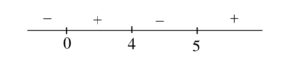
We analyze the sign of $f'(x)$ in the interval $x \in [1, 5]$.
Since $x > 0$, the sign depends on $(x-4)(x-5)$.
– For $1 \le x < 4$: $(x-4)$ is negative, $(x-5)$ is negative. Product is positive. $f(x)$ is increasing.
– For $4 < x < 5$: $(x-4)$ is positive, $(x-5)$ is negative. Product is negative. $f(x)$ is decreasing.
Thus, the maximum value occurs at $x=4$. The minimum value occurs at one of the endpoints $x=1$ or $x=5$.
First, find the explicit form of $f(x)$:
$$ f(x) = \int_0^x (t^3 – 9t^2 + 20t) dt = \left[ \frac{t^4}{4} – 3t^3 + 10t^2 \right]_0^x $$
$$ f(x) = \frac{x^4}{4} – 3x^3 + 10x^2 $$
Calculate values at critical points and endpoints:
1. $f(1) = \frac{1}{4} – 3 + 10 = 7.25 = \frac{29}{4}$
2. $f(4) = \frac{256}{4} – 3(64) + 10(16) = 64 – 192 + 160 = 32$
3. $f(5) = \frac{625}{4} – 3(125) + 10(25) = 156.25 – 375 + 250 = 31.25 = \frac{125}{4}$
Comparing the values:
Max ($\beta$) = 32
Min ($\alpha$) = $\frac{29}{4}$ (since $7.25 < 31.25$)
We need to find $4(\alpha + \beta)$:
$$ 4\left( \frac{29}{4} + 32 \right) = 29 + 128 = 157 $$
Ans. (1)
Was this solution helpful?
YesNo