Let the area of the region $\{(x,y): 2y \le x^{2}+3, \ y + |x| \le 3, \ y \ge |x-1|\}$ be $A$. Then $6A$ is equal to:
- (1) 16
- (2) 12
- (3) 18
- (4) 14
Solution:
The region is bounded by three inequalities:
1. $2y \le x^2 + 3 \Rightarrow y \le \frac{x^2+3}{2}$ (Parabola opening upwards, vertex at $(0, 1.5)$).
2. $y + |x| \le 3 \Rightarrow y \le 3 – |x|$.
3. $y \ge |x-1|$.
Finding intersection points:
Solve $y = 3-x$ and $y = \frac{x^2+3}{2}$ for $x>0$:
$3-x = \frac{x^2+3}{2} \Rightarrow 6-2x = x^2+3 \Rightarrow x^2+2x-3=0 \Rightarrow (x+3)(x-1)=0$.
So, at $x=1$, $y=2$. Point $C(1, 2)$.
Solve $y = 3+x$ and $y = \frac{x^2+3}{2}$ for $x<0$:
$3+x = \frac{x^2+3}{2} \Rightarrow 6+2x = x^2+3 \Rightarrow x^2-2x-3=0 \Rightarrow (x-3)(x+1)=0$.
So, at $x=-1$, $y=2$. Point $E(-1, 2)$.
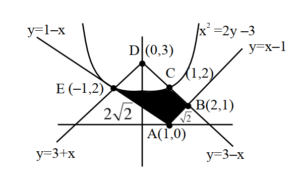
The region is bounded by the lines $y=3-x$, $y=3+x$, $y=|x-1|$ and the parabola.
Looking at the geometry, the required area $A$ can be calculated as:
Area $A = (\text{Area of Rectangle } ABDE) – (\text{Area of region under parabola and lines})$.
$A = 4 – 2\int_{0}^{1} \left( (3-x) – \left(\frac{x^2+3}{2}\right) \right) dx$.
$A = 4 – 2 \left[ 3x – \frac{x^2}{2} – \frac{x^3}{6} – \frac{3}{2}x \right]_{0}^{1}$
$A = 4 – 2 \left[ 3(1) – \frac{1}{2} – \frac{1}{6} – \frac{3}{2} \right]$
$A = 4 – 2 \left[ 3 – 2 – \frac{1}{6} \right] = 4 – 2 \left[ 1 – \frac{1}{6} \right] = 4 – 2 \left( \frac{5}{6} \right) = 4 – \frac{5}{3} = \frac{7}{3}$.
$\therefore 6A = 6 \times \frac{7}{3} = 14$.
Ans. (4)