Question ID: #891
Let $f(\alpha)$ denote the area of the region in the first quadrant bounded by $x=0, x=1, y^{2}=x$ and $y=|\alpha x-5|-|1-\alpha x|+\alpha x^{2}.$ Then $(f(0)+f(1))$ is equal to
- (1) 9
- (2) 14
- (3) 7
- (4) 12
Solution:
Case 1: Find $f(0)$ (Put $\alpha = 0$)
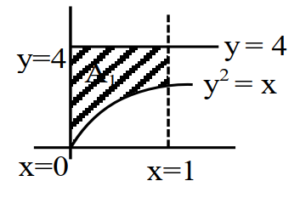
Curve: $y = |-5| – |1| + 0 = 5 – 1 = 4$
Region bounded by $x=0, x=1, y=\sqrt{x}, y=4$.
$$f(0) = \int_0^1 (4 – \sqrt{x}) dx = \left[4x – \frac{2}{3}x^{3/2}\right]_0^1$$
$$f(0) = 4 – \frac{2}{3} = \frac{10}{3}$$
Case 2: Find $f(1)$ (Put $\alpha = 1$)
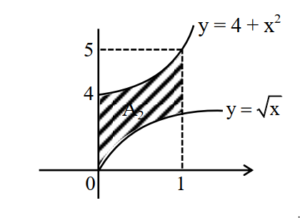
Curve: $y = |x – 5| – |1 – x| + x^2$. Since $x \in [0, 1]$, $x-5 < 0$ and $1-x > 0$.
$y = -(x – 5) – (1 – x) + x^2 = -x + 5 – 1 + x + x^2 = 4 + x^2$
Region bounded by $x=0, x=1, y=\sqrt{x}, y=4+x^2$.
$$f(1) = \int_0^1 ((4 + x^2) – \sqrt{x}) dx = \left[4x + \frac{x^3}{3} – \frac{2}{3}x^{3/2}\right]_0^1$$
$$f(1) = 4 + \frac{1}{3} – \frac{2}{3} = \frac{11}{3}$$
Total Sum:
$$f(0) + f(1) = \frac{10}{3} + \frac{11}{3} = \frac{21}{3} = 7$$
Ans. (3)
Was this solution helpful?
YesNo