If the area of the region $\{(x, y): 1-2x \le y \le 4-x^{2}, x \ge 0, y \ge 0\}$ is $\frac{\alpha}{\beta}$, where $\alpha, \beta \in N$ and $\gcd(\alpha,\beta)=1$, then the value of $(\alpha+\beta)$ is:
- (1) 73
- (2) 85
- (3) 91
- (4) 67
Solution:
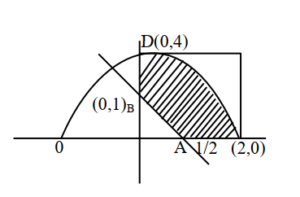
The required region is bounded by the parabola $y = 4-x^2$, the line $y = 1-2x$, and the coordinate axes ($x \ge 0, y \ge 0$).
First, find where the parabola intersects the x-axis by putting $y = 0$:
$$4-x^2 = 0 \Rightarrow x^2 = 4 \Rightarrow x = 2 \quad (\text{since } x \ge 0)$$
The line $y = 1-2x$ forms a right-angled triangle with the coordinate axes.
It intersects the x-axis at $A(1/2, 0)$ and the y-axis at $B(0, 1)$.
The required area is the total area under the parabola in the first quadrant minus the area of the unshaded triangle $OAB$.
$$Area = \int_{0}^{2} y_{\text{parabola}} \, dx – \text{Area of } \triangle OAB$$
$$Area = \int_{0}^{2} (4-x^2) \, dx – \left(\frac{1}{2} \times \text{base} \times \text{height}\right)$$
$$Area = \left[ 4x – \frac{x^3}{3} \right]_{0}^{2} – \left(\frac{1}{2} \times \frac{1}{2} \times 1\right)$$
$$Area = \left( 4(2) – \frac{2^3}{3} \right) – \frac{1}{4}$$
$$Area = \left( 8 – \frac{8}{3} \right) – \frac{1}{4}$$
$$Area = \left( \frac{24 – 8}{3} \right) – \frac{1}{4}$$
$$Area = \frac{16}{3} – \frac{1}{4}$$
Make the denominators equal by taking the LCM (12):
$$Area = \frac{64 – 3}{12}$$
$$Area = \frac{61}{12}$$
We are given that the area is $\frac{\alpha}{\beta}$.
Comparing both values, we get $\alpha = 61$ and $\beta = 12$.
Check the condition $\gcd(61, 12) = 1$. Since 61 is a prime number, this is satisfied.
Calculate the final value:
$$\alpha + \beta = 61 + 12 = 73$$
Ans. (1)