Let the distance between two parallel lines be 5 units and a point $P$ lie between the lines at a unit distance from one of them. An equilateral triangle $PQR$ is formed such that $Q$ lies on one of the parallel lines, while $R$ lies on the other. Then $(QR)^2$ is equal to
Solution:
Let the parallel lines be denoted by the top line ($L_1$) and bottom line ($L_2$). Distance between them is 5.
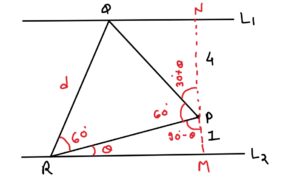
Let $P$ be at a distance of 1 unit from $L_2$. Thus, distance from $L_1$ is 4.
Let $M$ and $N$ be the feet of perpendiculars from $P$ to $L_2$ and $L_1$ respectively.
So, $PM = 1$ and $PN = 4$.
Let $\angle PRM = \theta$.
In $\Delta PRM$:
$$ \sin\theta = \frac{PM}{PR} = \frac{1}{PR} \Rightarrow PR = cosec\theta $$
Angle analysis at point $P$:
We know $\angle QPR = 60^\circ$ (Equilateral triangle).
In $\Delta PRM$, $\angle MPR = 90^\circ – \theta$.
Since $M, P, N$ are collinear (vertical line), the angle on the straight line is $180^\circ$.
$$ \angle QPN = 180^\circ – \angle QPR – \angle MPR $$
$$ \angle QPN = 180^\circ – 60^\circ – (90^\circ – \theta) = 30^\circ + \theta $$
In $\Delta PQN$:
$$ \cos(30^\circ+\theta) = \frac{PN}{PQ} = \frac{4}{PQ} \Rightarrow PQ = 4\sec(30^\circ+\theta) $$
Since $PQ = PR$:
$$ 4\sec(30^\circ+\theta) = cosec\theta $$
$$ \frac{4}{\cos(30^\circ+\theta)} = \frac{1}{\sin\theta} \Rightarrow 4\sin\theta = \cos(30^\circ+\theta) $$
Expanding $\cos(30^\circ+\theta)$:
$$ 4\sin\theta = \cos30^\circ\cos\theta – \sin30^\circ\sin\theta $$
$$ 4\sin\theta = \frac{\sqrt{3}}{2}\cos\theta – \frac{1}{2}\sin\theta $$
$$ 4\sin\theta + \frac{1}{2}\sin\theta = \frac{\sqrt{3}}{2}\cos\theta $$
$$ \frac{9}{2}\sin\theta = \frac{\sqrt{3}}{2}\cos\theta $$
$$ 9\sin\theta = \sqrt{3}\cos\theta \Rightarrow \tan\theta = \frac{\sqrt{3}}{9} = \frac{1}{3\sqrt{3}} $$
We need $(QR)^2 = (PR)^2 = \csc^2\theta$.
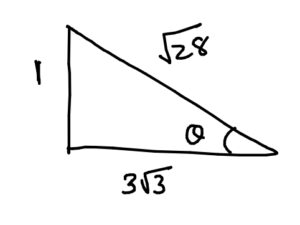
Constructing a right triangle with opposite side 1 and adjacent side $3\sqrt{3}$:
Hypotenuse $= \sqrt{(1)^2 + (3\sqrt{3})^2} = \sqrt{1 + 27} = \sqrt{28}$.
$$ \therefore cosec\theta = \frac{\text{Hypotenuse}}{\text{Opposite}} = \frac{\sqrt{28}}{1} = \sqrt{28} $$
$$ (QR)^2 = (\sqrt{28})^2 = 28 $$