Question ID: #881
Let the angles made with the positive x-axis by two straight lines drawn from the point $P(2,3)$ and meeting the line $x+y=6$ at a distance $\sqrt{\frac{2}{3}}$ from the point P be $\theta_{1}$ and $\theta_{2}$. Then the value of $(\theta_{1}+\theta_{2})$ is:
- (1) $\frac{\pi}{12}$
- (2) $\frac{\pi}{6}$
- (3) $\frac{\pi}{2}$
- (4) $\frac{\pi}{3}$
Solution:
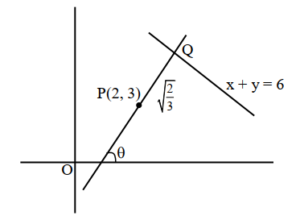
Let the point on the line be $Q$.
Using parametric form of a line:
$$Q \equiv (2 + r\cos\theta, 3 + r\sin\theta)$$
Given $r = \sqrt{\frac{2}{3}}$.
$$Q \equiv \left(2 + \sqrt{\frac{2}{3}}\cos\theta, 3 + \sqrt{\frac{2}{3}}\sin\theta\right)$$
Point Q lies on the line $x + y = 6$.
$$\left(2 + \sqrt{\frac{2}{3}}\cos\theta\right) + \left(3 + \sqrt{\frac{2}{3}}\sin\theta\right) = 6$$
$$5 + \sqrt{\frac{2}{3}}(\cos\theta + \sin\theta) = 6$$
$$\sqrt{\frac{2}{3}}(\cos\theta + \sin\theta) = 1$$
Squaring both sides (or using standard form):
$$\cos\theta + \sin\theta = \sqrt{\frac{3}{2}}$$
Multiply and divide by $\sqrt{2}$ on LHS:
$$\sqrt{2}\left(\frac{1}{\sqrt{2}}\cos\theta + \frac{1}{\sqrt{2}}\sin\theta\right) = \sqrt{\frac{3}{2}}$$
$$\sin\left(\theta + \frac{\pi}{4}\right) = \frac{\sqrt{3}}{2}$$
$$\theta + \frac{\pi}{4} = \frac{\pi}{3} \quad \text{or} \quad \theta + \frac{\pi}{4} = \frac{2\pi}{3}$$
$$\theta_1 = \frac{\pi}{3} – \frac{\pi}{4} = \frac{\pi}{12}$$
$$\theta_2 = \frac{2\pi}{3} – \frac{\pi}{4} = \frac{5\pi}{12}$$
$$\theta_1 + \theta_2 = \frac{\pi}{12} + \frac{5\pi}{12} = \frac{6\pi}{12} = \frac{\pi}{2}$$
Ans. (3)
Was this solution helpful?
YesNo