Question ID: #782
A rectangle is formed by the lines $x=0$, $y=0$, $x=3$ and $y=4$. Let the line $L$ be perpendicular to $3x+y+6=0$ and divide the area of the rectangle into two equal parts. Then the distance of the point $\left(\frac{1}{2}, -5\right)$ from the line $L$ is equal to:
- (1) $2\sqrt{5}$
- (2) $3\sqrt{10}$
- (3) $\sqrt{10}$
- (4) $2\sqrt{10}$
Solution:
The vertices of the rectangle are $(0,0), (3,0), (3,4),$ and $(0,4)$.
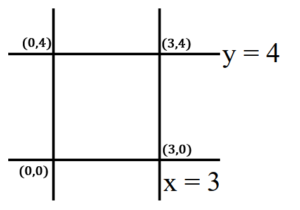
Any line that bisects the area of a rectangle must pass through its center (centroid).
Center of rectangle = Midpoint of diagonal connecting $(0,0)$ and $(3,4)$:
$$ C = \left( \frac{0+3}{2}, \frac{0+4}{2} \right) = \left( \frac{3}{2}, 2 \right) $$
The given line is $3x+y+6=0$. Its slope is $m_1 = -3$.
Line $L$ is perpendicular to this line, so its slope $m_L$ is:
$$ m_L = -\frac{1}{m_1} = \frac{1}{3} $$
Equation of line $L$ passing through $\left( \frac{3}{2}, 2 \right)$ with slope $\frac{1}{3}$:
$$ y – 2 = \frac{1}{3}\left( x – \frac{3}{2} \right) $$
Multiply by 6 to clear fractions:
$$ 6(y – 2) = 2\left( x – \frac{3}{2} \right) $$
$$ 6y – 12 = 2x – 3 $$
$$ 2x – 6y + 9 = 0 $$
Distance of point $P\left(\frac{1}{2}, -5\right)$ from $2x – 6y + 9 = 0$:
$$ d = \frac{|Ax_1 + By_1 + C|}{\sqrt{A^2 + B^2}} $$
$$ d = \frac{|2(1/2) – 6(-5) + 9|}{\sqrt{2^2 + (-6)^2}} $$
$$ d = \frac{|1 + 30 + 9|}{\sqrt{4 + 36}} = \frac{40}{\sqrt{40}} $$
$$ d = \sqrt{40} = 2\sqrt{10} $$
Ans. (4)
Was this solution helpful?
YesNo