A line passing through the point $P(\sqrt{5}, \sqrt{5})$ intersects the ellipse $\frac{x^{2}}{36}+\frac{y^{2}}{25}=1$ at $A$ and $B$ such that $(PA) \cdot (PB)$ is maximum. Then $5(PA^{2}+PB^{2})$ is equal to
- (1) 218
- (2) 377
- (3) 290
- (4) 338
Solution:
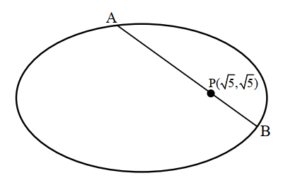
$$\frac{x^2}{36} + \frac{y^2}{25} = 1$$
$$x = \sqrt{5} + r\cos\theta, \quad y = \sqrt{5} + r\sin\theta$$
$$25(\sqrt{5} + r\cos\theta)^2 + 36(\sqrt{5} + r\sin\theta)^2 = 900$$
$$25(5 + r^2\cos^2\theta + 2\sqrt{5}r\cos\theta) + 36(5 + r^2\sin^2\theta + 2\sqrt{5}r\sin\theta) = 900$$
$$r^2(25\cos^2\theta + 36\sin^2\theta) + 2\sqrt{5}r(25\cos\theta + 36\sin\theta) + 125 + 180 – 900 = 0$$
$$r^2(25\cos^2\theta + 36\sin^2\theta) + 2\sqrt{5}r(25\cos\theta + 36\sin\theta) – 595 = 0$$
$$PA \cdot PB = |r_1 r_2| = \left| \frac{-595}{25\cos^2\theta + 36\sin^2\theta} \right|$$
$$PA \cdot PB = \frac{595}{25(1-\sin^2\theta) + 36\sin^2\theta}$$
$$PA \cdot PB = \frac{595}{25 + 11\sin^2\theta}$$
$$PA \cdot PB \text{ is maximum when } \sin^2\theta = 0$$
$$\sin\theta = 0 \Rightarrow \text{Line } AB \text{ is parallel to x-axis.}$$
$$y_A = y_B = \sqrt{5}$$
$$\frac{x^2}{36} + \frac{(\sqrt{5})^2}{25} = 1$$
$$\frac{x^2}{36} = 1 – \frac{1}{5} = \frac{4}{5}$$
$$x^2 = \frac{144}{5}$$
$$x = \pm \frac{12}{\sqrt{5}}$$
$$A\left(-\frac{12}{\sqrt{5}}, \sqrt{5}\right), \quad B\left(\frac{12}{\sqrt{5}}, \sqrt{5}\right)$$
$$PA^2 = \left( \sqrt{5} – \left(-\frac{12}{\sqrt{5}}\right) \right)^2 + (\sqrt{5} – \sqrt{5})^2 = \left( \sqrt{5} + \frac{12}{\sqrt{5}} \right)^2 = \left( \frac{17}{\sqrt{5}} \right)^2 = \frac{289}{5}$$
$$PB^2 = \left( \sqrt{5} – \frac{12}{\sqrt{5}} \right)^2 + (\sqrt{5} – \sqrt{5})^2 = \left( \frac{5 – 12}{\sqrt{5}} \right)^2 = \left( \frac{-7}{\sqrt{5}} \right)^2 = \frac{49}{5}$$
$$PA^2 + PB^2 = \frac{289}{5} + \frac{49}{5} = \frac{338}{5}$$
$$5(PA^2 + PB^2) = 338$$
Ans. (4)