Question ID: #716
If P is a point on the circle $x^2 + y^2 = 4$, Q is a point on the straight line $5x + y + 2 = 0$ and $x – y + 1 = 0$ is the perpendicular bisector of PQ, then 13 times the sum of abscissa of all such point P is _______.
Solution:
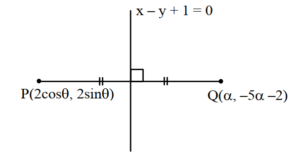
Let the coordinates of point P on the circle $x^2 + y^2 = 4$ be:
$$ P(2\cos\theta, 2\sin\theta) $$
Since Q lies on the line $5x + y + 2 = 0$, let the coordinates of Q be:
$$ Q(\alpha, -5\alpha – 2) $$
The line $x – y + 1 = 0$ is the perpendicular bisector of PQ. Therefore, the midpoint of PQ lies on this line.
The midpoint $M$ of PQ is:
$$ M \left( \frac{2\cos\theta + \alpha}{2}, \frac{2\sin\theta – 5\alpha – 2}{2} \right) $$
Substituting coordinates of M into $x – y + 1 = 0$:
$$ \frac{2\cos\theta + \alpha}{2} – \frac{2\sin\theta – 5\alpha – 2}{2} + 1 = 0 $$
Multiplying by 2:
$$ (2\cos\theta + \alpha) – (2\sin\theta – 5\alpha – 2) + 2 = 0 $$
$$ 2\cos\theta + \alpha – 2\sin\theta + 5\alpha + 2 + 2 = 0 $$
$$ \cos\theta – \sin\theta + 3\alpha + 2 = 0 \quad \dots(1) $$
Also, PQ is perpendicular to the line $x – y + 1 = 0$. The slope of the line $x – y + 1 = 0$ is $1$.
Therefore, the slope of PQ must be $-1$:
$$ \frac{2\sin\theta – (-5\alpha – 2)}{2\cos\theta – \alpha} = -1 $$
$$ 2\sin\theta + 5\alpha + 2 = -(2\cos\theta – \alpha) $$
$$ 2\sin\theta + 5\alpha + 2 = -2\cos\theta + \alpha $$
$$ \sin\theta + \cos\theta + 2\alpha + 1 = 0 \quad \dots(2) $$
Now we eliminate $\alpha$ from equations (1) and (2).
From (2), we get $2\alpha = -(\sin\theta + \cos\theta + 1) \Rightarrow \alpha = \frac{-\sin\theta – \cos\theta – 1}{2}$.
Substituting $\alpha$ into (1):
$$ \cos\theta – \sin\theta + 3\left( \frac{-\sin\theta – \cos\theta – 1}{2} \right) + 2 = 0 $$
Multiplying by 2:
$$ 2\cos\theta – 2\sin\theta – 3\sin\theta – 3\cos\theta – 3 + 4 = 0 $$
$$ -\cos\theta – 5\sin\theta + 1 = 0 $$
$$ \cos\theta + 5\sin\theta = 1 $$
We solve for $\theta$ using half-angle formulae, where $\cos\theta = 1 – 2\sin^2\frac{\theta}{2}$ and $\sin\theta = 2\sin\frac{\theta}{2}\cos\frac{\theta}{2}$:
$$ \left(1 – 2\sin^2\frac{\theta}{2}\right) + 5\left(2\sin\frac{\theta}{2}\cos\frac{\theta}{2}\right) = 1 $$
$$ -2\sin^2\frac{\theta}{2} + 10\sin\frac{\theta}{2}\cos\frac{\theta}{2} = 0 $$
$$ 2\sin\frac{\theta}{2} \left( -\sin\frac{\theta}{2} + 5\cos\frac{\theta}{2} \right) = 0 $$
Case 1: $\sin\frac{\theta}{2} = 0 \Rightarrow \frac{\theta}{2} = 0 \Rightarrow \theta = 0$.
The abscissa of P is $x = 2\cos(0) = 2(1) = 2$.
Case 2: $-\sin\frac{\theta}{2} + 5\cos\frac{\theta}{2} = 0 \Rightarrow \tan\frac{\theta}{2} = 5$.
We find $\cos\theta$:
$$ \cos\theta = \frac{1 – \tan^2\frac{\theta}{2}}{1 + \tan^2\frac{\theta}{2}} = \frac{1 – 5^2}{1 + 5^2} = \frac{1 – 25}{1 + 25} = \frac{-24}{26} = \frac{-12}{13} $$
The abscissa of P is $x = 2\cos\theta = 2\left(\frac{-12}{13}\right) = \frac{-24}{13}$.
The sum of all possible values of abscissa of point P is:
$$ \text{Sum} = 2 + \left( \frac{-24}{13} \right) = \frac{26 – 24}{13} = \frac{2}{13} $$
We need to find 13 times this sum:
$$ 13 \times \frac{2}{13} = 2 $$
Ans. 2
Was this solution helpful?
YesNo