Question ID: #967
Let $A=\{z\in\mathbb{C}:|z-2|\le4\}$ and $B=\{z\in\mathbb{C}:|z-2|+|z+2|=5\}$. Then the max $\{|z_{1}-z_{2}|:z_{1}\in A \text{ and } z_{2}\in B\}$ is
- (1) $\frac{15}{2}$
- (2) 8
- (3) $\frac{17}{2}$
- (4) 9
Solution:
Region A: $|z-2| \le 4$ represents a circular disc centered at $C_A(2, 0)$ with radius $R=4$.
The real values of $z$ in A range from $2-4=-2$ to $2+4=6$.
Region B: $|z-2| + |z-(-2)| = 5$. This represents an ellipse with foci at $(2,0)$ and $(-2,0)$.
Length of major axis $2a = 5 \Rightarrow a = 2.5$.
Center is midpoint of foci, $C_B(0,0)$.
Major axis lies along the real axis (x-axis).
The vertices of the ellipse are at $(\pm a, 0) = (\pm 2.5, 0)$.
So, real values of $z$ in B range from $-2.5$ to $2.5$.
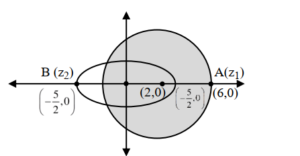
We want to maximize $|z_1 – z_2|$ where $z_1 \in A$ and $z_2 \in B$.
Geometrically, the maximum distance will be between the extreme points along the common major axis (real axis).
Leftmost point of B is $z_2 = -2.5$.
Rightmost point of A is $z_1 = 6$.
Distance = $|6 – (-2.5)| = 8.5$.
Check other pair:
Leftmost point of A is $z_1 = -2$.
Rightmost point of B is $z_2 = 2.5$.
Distance = $|2.5 – (-2)| = 4.5$.
Maximum distance is $8.5 = \frac{17}{2}$.
Ans. (3)
Was this solution helpful?
YesNo