Question ID: #370
Let circle C be the image of $x^{2}+y^{2}-2x+4y-4=0$ in the line $2x-3y+5=0$ and A be the point on C such that OA is parallel to x-axis and A lies on the right hand side of the centre O of C. If $B(\alpha,\beta)$, with $\beta<4$ lies on C such that the length of the arc AB is $(1/6)^{th}$ of the perimeter of C, then $\beta-\sqrt{3}\alpha$ is equal to
- (1) 3
- (2) $3+\sqrt{3}$
- (3) $4-\sqrt{3}$
- (4) 4
Solution:
First circle equation: $(x-1)^2 + (y+2)^2 – 1 – 4 – 4 = 0 \Rightarrow (x-1)^2 + (y+2)^2 = 9$.
Center $O_1(1, -2)$, Radius $r=3$.
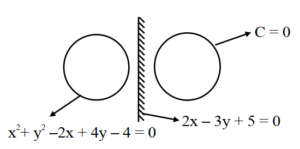
Find the center $O(h,k)$ of the reflected circle C about the line $2x-3y+5=0$.
Using image formula:
$$ \frac{h-1}{2} = \frac{k+2}{-3} = -2 \frac{2(1) – 3(-2) + 5}{2^2 + (-3)^2} $$
$$ \frac{h-1}{2} = \frac{k+2}{-3} = -2 \frac{2 + 6 + 5}{13} = -2 \frac{13}{13} = -2 $$
$$ h-1 = -4 \Rightarrow h = -3 $$
$$ k+2 = 6 \Rightarrow k = 4 $$
So, Center $O(-3, 4)$ and Radius $r=3$.
Point A is on the circle, OA is parallel to x-axis, and A is to the right of O.
Since it’s parallel to x-axis, y-coordinate is same as center: $y_A = 4$.
Since it’s to the right, $x_A = h + r = -3 + 3 = 0$.
So, $A(0, 4)$.
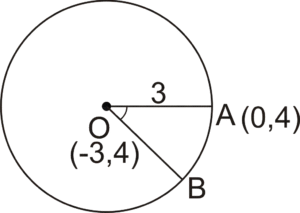
Length of arc AB is $1/6$ of perimeter. Angle subtended $\theta = \frac{2\pi}{6} = \frac{\pi}{3} = 60^\circ$.
Point B is obtained by rotating A by $60^\circ$ about O.
Condition $\beta < 4$ implies B is below the horizontal line OA. We rotate clockwise (-60 degrees). Using rotation of vector $\vec{OA} = (3, 0)$: $$ x_{new} = 3 \cos(-60^\circ) = 3(1/2) = 1.5 $$ $$ y_{new} = 3 \sin(-60^\circ) = 3(-\sqrt{3}/2) = -1.5\sqrt{3} $$ Coordinates of B relative to O are $(1.5, -1.5\sqrt{3})$. Absolute coordinates $B(\alpha, \beta)$: $$ \alpha = -3 + 1.5 = -1.5 = -\frac{3}{2} $$ $$ \beta = 4 - 1.5\sqrt{3} = 4 - \frac{3\sqrt{3}}{2} $$
Calculate $\beta – \sqrt{3}\alpha$:
$$ \left(4 – \frac{3\sqrt{3}}{2}\right) – \sqrt{3}\left(-\frac{3}{2}\right) $$
$$ = 4 – \frac{3\sqrt{3}}{2} + \frac{3\sqrt{3}}{2} = 4 $$
Ans. (4)
Was this solution helpful?
YesNo