Let $f : \mathbb{R} \to \mathbb{R}$ be a twice differentiable function such that $f(x+y) = f(x)f(y)$ for all $x, y \in \mathbb{R}$. If $f'(0) = 4a$ and $f$ satisfies $f”(x) – 3af'(x) – f(x) = 0$, $a > 0$, then the area of the region $R = \{(x, y) \mid 0 \le y \le f(ax), \ 0 \le x \le 2\}$ is:
- (1) $e^2 – 1$
- (2) $e^4 + 1$
- (3) $e^4 – 1$
- (4) $e^2 + 1$
Solution:
Given $f(x+y) = f(x)f(y) \Rightarrow f(x) = e^{\lambda x}$.
Differentiating w.r.t $x$, $f'(x) = \lambda e^{\lambda x} \Rightarrow f'(0) = \lambda$.
Since $f'(0) = 4a$, we have $\lambda = 4a$, so $f(x) = e^{4ax}$.
Substituting $f(x)$ in the given differential equation $f”(x) – 3af'(x) – f(x) = 0$:
$$ 16a^2 e^{4ax} – 3a(4a e^{4ax}) – e^{4ax} = 0 $$
$$ \Rightarrow e^{4ax} (16a^2 – 12a^2 – 1) = 0 $$
$$ \Rightarrow 4a^2 = 1 \Rightarrow a = \frac{1}{2} \quad (\because a > 0) $$
Now, the function in the region is $y = f(ax) = e^{4a(ax)} = e^{4a^2 x}$.
Since $a = 1/2$, we get $4a^2 = 1$, so $y = e^x$.
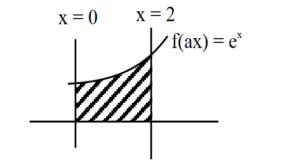
Required Area $\displaystyle A = \int_{0}^{2} y \, dx = \int_{0}^{2} e^x \, dx$
$$ A = [e^x]_{0}^{2} = e^2 – e^0 = e^2 – 1 $$
Ans. (1)