Question ID: #444
The sum of all local minimum values of the function f(x) given below is:
$f(x) = \begin{cases} 1-2x, & x < -1 \\ \frac{1}{3}(7+2|x|), & -1 \le x \le 2 \\ \frac{11}{18}(x-4)(x-5), & x > 2 \end{cases}$
- (1) $\frac{171}{72}$
- (2) $\frac{131}{72}$
- (3) $\frac{157}{72}$
- (4) $\frac{167}{72}$
Solution:
We analyze the local minima in each interval based on the function definition and its graph.
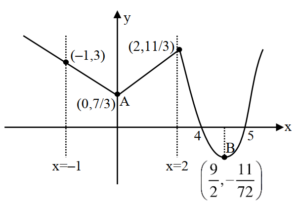
1. Interval $x < -1$:
$f(x) = 1 – 2x$.
This is a decreasing linear function (slope = -2). No local minimum exists strictly inside this interval.
At the boundary $x = -1$, the value is $1 – 2(-1) = 3$.
2. Interval $-1 \le x \le 2$:
$f(x) = \frac{1}{3}(7 + 2|x|)$.
This describes a V-shaped function symmetric about the y-axis.
At $x = -1$, $f(-1) = \frac{1}{3}(7 + 2) = 3$. (Continuous with the first branch).
As $x$ goes from -1 to 0, the function decreases.
As $x$ goes from 0 to 2, the function increases.
Thus, a local minimum occurs at the vertex $x = 0$.
Value at $x = 0$:
$$ f(0) = \frac{1}{3}(7 + 0) = \frac{7}{3} $$
3. Interval $x > 2$:
$f(x) = \frac{11}{18}(x^2 – 9x + 20)$.
This is an upward-opening parabola. The minimum occurs at the vertex $x = -b/2a$.
$$ x_v = \frac{9}{2(1)} = 4.5 $$
Since $4.5 > 2$, this critical point lies in the domain.
Value at $x = 4.5$:
$$ f(4.5) = \frac{11}{18}(4.5 – 4)(4.5 – 5) $$
$$ = \frac{11}{18}(0.5)(-0.5) = \frac{11}{18} \left( -\frac{1}{4} \right) = -\frac{11}{72} $$
4. Total Sum:
Sum of local minimum values = $f(0) + f(4.5)$
$$ \text{Sum} = \frac{7}{3} – \frac{11}{72} $$
$$ = \frac{7 \times 24}{72} – \frac{11}{72} $$
$$ = \frac{168 – 11}{72} = \frac{157}{72} $$
Ans. (3)
Was this solution helpful?
YesNo