Question ID: #318
A spherical chocolate ball has a layer of ice-cream of uniform thickness around it. When the thickness of the ice-cream layer is $1 \text{ cm}$, the ice-cream melts at the rate of $81 \text{ cm}^3/\text{min}$ and the thickness of the ice-cream layer decreases at the rate of $\frac{1}{4\pi} \text{ cm/min}$. The surface area (in $\text{cm}^2$) of the chocolate ball (without the ice-cream layer) is:
- (1) $225 \pi$
- (2) $128 \pi$
- (3) $196 \pi$
- (4) $256 \pi$
Solution:
Let $R$ be the radius of the inner chocolate ball (which is constant).
Let $x$ be the thickness of the ice-cream layer.
The total radius of the sphere (chocolate + ice-cream) is $r = R + x$.
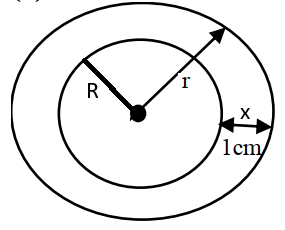
The volume of the spherical system is given by:
$$V = \frac{4}{3}\pi r^3$$
Differentiating with respect to time $t$:
$$\frac{dV}{dt} = \frac{4}{3}\pi \cdot 3r^2 \frac{dr}{dt}$$
$$\frac{dV}{dt} = 4\pi r^2 \frac{dr}{dt}$$
Since $R$ is constant, the rate of change of the total radius is the same as the rate of change of the thickness:
$$\frac{dr}{dt} = \frac{d(R+x)}{dt} = \frac{dx}{dt}$$
We are given:
Rate of change of volume (melting), $\frac{dV}{dt} = 81 \text{ cm}^3/\text{min}$ (considering magnitude).
Rate of change of thickness, $\frac{dx}{dt} = \frac{1}{4\pi} \text{ cm/min}$.
Substitute these values into the differentiated equation:
$$81 = 4\pi r^2 \left( \frac{1}{4\pi} \right)$$
$$81 = r^2$$
$$r = 9 \text{ cm}$$
At this instant, the thickness of the ice-cream is $x = 1 \text{ cm}$.
Therefore, the radius of the chocolate ball is:
$$R = r – x = 9 – 1 = 8 \text{ cm}$$
The surface area of the chocolate ball is:
$$S = 4\pi R^2$$
$$S = 4\pi (8)^2$$
$$S = 64 \times 4\pi = 256\pi$$
Ans. (4)
Was this solution helpful?
YesNo