Question ID: #358
Let in a $\Delta ABC$, the length of the side $AC$ be 6, the vertex $B$ be $(1, 2, 3)$ and the vertices $A, C$ lie on the line $\frac{x-6}{3}=\frac{y-7}{2}=\frac{z-7}{-2}$. Then the area (in sq. units) of $\Delta ABC$ is
- (1) 42
- (2) 21
- (3) 56
- (4) 17
Solution:
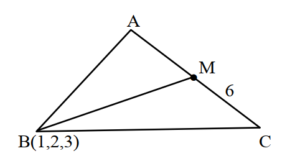
Let the line containing $AC$ be $L$. A point $M$ on this line can be assumed as general coordinates:
$$ M = (3\lambda + 6, 2\lambda + 7, -2\lambda + 7) $$
We find the foot of the perpendicular from $B(1,2,3)$ to the line. Let $\vec{BM}$ be the vector from $B$ to $M$:
$$ \vec{BM} = (3\lambda + 6 – 1)\hat{i} + (2\lambda + 7 – 2)\hat{j} + (-2\lambda + 7 – 3)\hat{k} $$
$$ \vec{BM} = (3\lambda + 5)\hat{i} + (2\lambda + 5)\hat{j} + (-2\lambda + 4)\hat{k} $$
Since $\vec{BM}$ is perpendicular to the direction vector of the line $\vec{d} = 3\hat{i} + 2\hat{j} – 2\hat{k}$:
$$ \vec{BM} \cdot \vec{d} = 0 $$
$$ 3(3\lambda + 5) + 2(2\lambda + 5) – 2(-2\lambda + 4) = 0 $$
$$ 9\lambda + 15 + 4\lambda + 10 + 4\lambda – 8 = 0 $$
$$ 17\lambda + 17 = 0 \Rightarrow \lambda = -1 $$
Substitute $\lambda = -1$ back into $\vec{BM}$ to find the height $h$:
$$ \vec{BM} = (3(-1)+5)\hat{i} + (2(-1)+5)\hat{j} + (-2(-1)+4)\hat{k} $$
$$ \vec{BM} = 2\hat{i} + 3\hat{j} + 6\hat{k} $$
$$ h = |\vec{BM}| = \sqrt{2^2 + 3^2 + 6^2} = \sqrt{4 + 9 + 36} = \sqrt{49} = 7 $$
The base of the triangle is side $AC$, given as 6.
$$ \text{Area} = \frac{1}{2} \times \text{base} \times \text{height} $$
$$ \text{Area} = \frac{1}{2} \times 6 \times 7 = 21 $$
Ans. (2)
Was this solution helpful?
YesNo