Question ID: #598
Let the vertices $Q$ and $R$ of the triangle $PQR$ lie on the line $\frac{x+3}{5}=\frac{y-1}{2}=\frac{z+4}{3}$ and the coordinates of the point $P$ be $(0, 2, 3)$. If the area of the triangle $PQR$ is $\frac{m}{n}$ and $QR=5$, then:
- (1) $m-5\sqrt{21}n=0$
- (2) $2m-5\sqrt{21}n=0$
- (3) $5m-2\sqrt{21}n=0$
- (4) $5m-21\sqrt{2}n=0$
Solution:
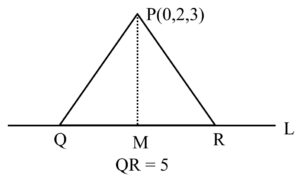
Let $M$ be the foot of the perpendicular from $P(0,2,3)$ to the given line.
The general point on the line is $M(5\lambda-3, 2\lambda+1, 3\lambda-4)$.
The direction ratios of $PM$ are:
$$(5\lambda-3-0, 2\lambda+1-2, 3\lambda-4-3) = (5\lambda-3, 2\lambda-1, 3\lambda-7)$$
Since $PM$ is perpendicular to the line (direction ratios 5, 2, 3):
$$5(5\lambda-3) + 2(2\lambda-1) + 3(3\lambda-7) = 0$$
$$25\lambda – 15 + 4\lambda – 2 + 9\lambda – 21 = 0$$
$$38\lambda – 38 = 0 \Rightarrow \lambda = 1$$
Substitute $\lambda=1$ to find $M$:
$$M(2, 3, -1)$$
Calculate the height $PM$:
$$PM = \sqrt{(2-0)^2 + (3-2)^2 + (-1-3)^2}$$
$$PM = \sqrt{4 + 1 + 16} = \sqrt{21}$$
The area of $\triangle PQR$ with base $QR=5$ is:
$$\text{Area} = \frac{1}{2} \times \text{base} \times \text{height} = \frac{1}{2} \times 5 \times \sqrt{21} = \frac{5\sqrt{21}}{2}$$
Given Area $= \frac{m}{n}$, we have:
$$\frac{m}{n} = \frac{5\sqrt{21}}{2} \Rightarrow 2m = 5\sqrt{21}n \Rightarrow 2m – 5\sqrt{21}n = 0$$
Ans. (2)
Was this solution helpful?
YesNo