Question ID: #992
If the image of the point $P(1,0,3)$ in the line joining the points $A(4,7,1)$ and $B(3,5,3)$ is $Q(\alpha,\beta,\gamma)$ then $\alpha+\beta+\gamma$ is equal to
- (1) $\frac{47}{3}$
- (2) $\frac{46}{3}$
- (3) $18$
- (4) $13$
Solution:
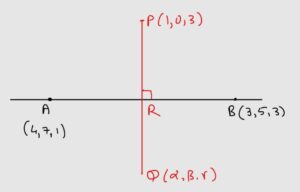
Equation of the line joining points $A(x_1, y_1, z_1)$ and $B(x_2, y_2, z_2)$ is:
$$ \frac{x-x_1}{x_2-x_1} = \frac{y-y_1}{y_2-y_1} = \frac{z-z_1}{z_2-z_1} $$
Equation of line $AB$ passing through $A(4,7,1)$ and $B(3,5,3)$:
$$ \frac{x-3}{4-3} = \frac{y-5}{7-5} = \frac{z-3}{1-3} $$
$$ \frac{x-3}{1} = \frac{y-5}{2} = \frac{z-3}{-2} = \lambda $$
Let the foot of the perpendicular from point $P(1,0,3)$ to the line $AB$ be $R$.
Coordinates of any point $R$ on the line are:
$$ R \equiv (\lambda+3, 2\lambda+5, -2\lambda+3) $$
Direction ratios of the line segment $PR$:
$$ (x_R – x_P, y_R – y_P, z_R – z_P) $$
$$ (\lambda+3-1, 2\lambda+5-0, -2\lambda+3-3) = (\lambda+2, 2\lambda+5, -2\lambda) $$
Since $PR$ is perpendicular to the line $AB$, the dot product of their direction ratios is zero:
$$ a_1a_2 + b_1b_2 + c_1c_2 = 0 $$
$$ 1(\lambda+2) + 2(2\lambda+5) – 2(-2\lambda) = 0 $$
$$ \lambda + 2 + 4\lambda + 10 + 4\lambda = 0 $$
$$ 9\lambda + 12 = 0 \Rightarrow \lambda = -\frac{4}{3} $$
Substitute $\lambda$ back to find the coordinates of $R$:
$$ R = \left( -\frac{4}{3}+3, 2\left(-\frac{4}{3}\right)+5, -2\left(-\frac{4}{3}\right)+3 \right) = \left( \frac{5}{3}, \frac{7}{3}, \frac{17}{3} \right) $$
$R$ is the midpoint of $P(1,0,3)$ and its image $Q(\alpha,\beta,\gamma)$.
$$ R = \left( \frac{x_P+x_Q}{2}, \frac{y_P+y_Q}{2}, \frac{z_P+z_Q}{2} \right) $$
$$ \left( \frac{5}{3}, \frac{7}{3}, \frac{17}{3} \right) = \left( \frac{1+\alpha}{2}, \frac{0+\beta}{2}, \frac{3+\gamma}{2} \right) $$
$$ \frac{1+\alpha}{2} = \frac{5}{3} \Rightarrow \alpha = \frac{10}{3} – 1 = \frac{7}{3} $$
$$ \frac{\beta}{2} = \frac{7}{3} \Rightarrow \beta = \frac{14}{3} $$
$$ \frac{3+\gamma}{2} = \frac{17}{3} \Rightarrow \gamma = \frac{34}{3} – 3 = \frac{25}{3} $$
$$ \alpha+\beta+\gamma = \frac{7}{3} + \frac{14}{3} + \frac{25}{3} = \frac{46}{3} $$
Ans. (2)
Was this solution helpful?
YesNo