Question ID: #931
If the distances of the point $(1, 2, a)$ from the line $\frac{x-1}{1}=\frac{y}{2}=\frac{z-1}{1}$ along the lines $L_{1}: \frac{x-1}{3}=\frac{y-2}{4}=\frac{z-a}{b}$ and $L_{2}: \frac{x-1}{1}=\frac{y-2}{4}=\frac{z-a}{c}$ are equal, then $a+b+c$ is equal to
- (1) 7
- (2) 5
- (3) 6
- (4) 4
Solution:
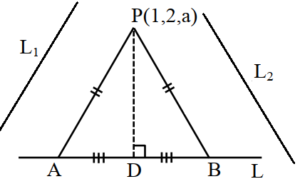
Let $P(1, 2, a)$ be the given point.
Let the line $L$ be $\frac{x-1}{1}=\frac{y}{2}=\frac{z-1}{1} = \lambda$.
Any point on line $L$ is $Q(\lambda+1, 2\lambda, \lambda+1)$.
The distance is measured along lines $L_1$ and $L_2$.
Line $L_1$ passes through $P(1, 2, a)$ and has direction ratios $(3, 4, b)$.
Line $L_2$ passes through $P(1, 2, a)$ and has direction ratios $(1, 4, c)$.
Let $A$ be the point of intersection of $L$ and $L_1$.
Since $A$ lies on $L$, $A = (\lambda+1, 2\lambda, \lambda+1)$ for some $\lambda$.
Since $A$ lies on $L_1$ passing through $P(1, 2, a)$:
$$\frac{(\lambda+1)-1}{3} = \frac{2\lambda-2}{4} = \frac{(\lambda+1)-a}{b}$$
$$\frac{\lambda}{3} = \frac{2(\lambda-1)}{4} \Rightarrow \frac{\lambda}{3} = \frac{\lambda-1}{2}$$
$$2\lambda = 3\lambda – 3 \Rightarrow \lambda = 3$$
Substitute $\lambda=3$ into the third part:
$$\frac{3}{3} = \frac{4-a}{b} \Rightarrow 1 = \frac{4-a}{b} \Rightarrow b = 4-a \Rightarrow a+b=4$$
Point $A$ is $(4, 6, 4)$.
Let $B$ be the point of intersection of $L$ and $L_2$.
Since $B$ lies on $L$, $B = (\mu+1, 2\mu, \mu+1)$ for some $\mu$.
Since $B$ lies on $L_2$ passing through $P(1, 2, a)$:
$$\frac{(\mu+1)-1}{1} = \frac{2\mu-2}{4} = \frac{(\mu+1)-a}{c}$$
$$\frac{\mu}{1} = \frac{2(\mu-1)}{4} \Rightarrow \mu = \frac{\mu-1}{2}$$
$$2\mu = \mu – 1 \Rightarrow \mu = -1$$
Substitute $\mu=-1$ into the third part:
$$\frac{-1}{1} = \frac{0-a}{c} \Rightarrow -1 = \frac{-a}{c} \Rightarrow c = a$$
Point $B$ is $(0, -2, 0)$.
Given that the distances are equal, i.e., $PA = PB$.
$$PA^2 = PB^2$$
$$(4-1)^2 + (6-2)^2 + (4-a)^2 = (0-1)^2 + (-2-2)^2 + (0-a)^2$$
$$3^2 + 4^2 + (4-a)^2 = (-1)^2 + (-4)^2 + a^2$$
$$9 + 16 + (16 – 8a + a^2) = 1 + 16 + a^2$$
$$41 – 8a + a^2 = 17 + a^2$$
$$24 = 8a \Rightarrow a = 3$$
Since $a=3$, we have:
$$b = 4 – a = 4 – 3 = 1$$
$$c = a = 3$$
We need $a+b+c$:
$$a+b+c = 3 + 1 + 3 = 7$$
Ans. (1)
Was this solution helpful?
YesNo