Let $(2\alpha, \alpha)$ be the largest interval in which the function $f(t)=\frac{|t+1|}{t^{2}}, t<0$, is strictly decreasing. Then the local maximum value of the function $g(x)=2\log_{e}(x-2)+\alpha x^{2}+4x-\alpha, x>2$, is
Solution:
For $t < 0$, we analyze $f(t)$ in two cases based on the modulus $|t+1|$.
Case 1: $-1 \le t < 0$
$$f(t) = \frac{t+1}{t^2} = t^{-1} + t^{-2}$$
$$f'(t) = -t^{-2} - 2t^{-3} = -\frac{1}{t^2} - \frac{2}{t^3} = -\frac{t+2}{t^3}$$
Since $t \in [-1, 0)$, $t^3 < 0$ and $t+2 > 0$. Thus $f'(t) > 0$ (Strictly Increasing).
Case 2: $t < -1$
$$f(t) = \frac{-(t+1)}{t^2} = -t^{-1} - t^{-2}$$
$$f'(t) = t^{-2} + 2t^{-3} = \frac{1}{t^2} + \frac{2}{t^3} = \frac{t+2}{t^3}$$
For $f(t)$ to be strictly decreasing, $f'(t) < 0$:
$$\frac{t+2}{t^3} < 0$$
Since $t < -1$, $t^3 < 0$. Therefore, we need $t+2 > 0 \Rightarrow t > -2$.
So, the interval is $(-2, -1)$.
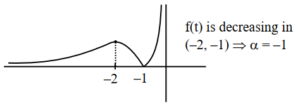
Comparing $(-2, -1)$ with $(2\alpha, \alpha)$:
$$\alpha = -1$$
Now, substitute $\alpha = -1$ into $g(x)$:
$$g(x) = 2\log_{e}(x-2) – x^2 + 4x + 1$$
Differentiate w.r.t $x$:
$$g'(x) = \frac{2}{x-2} – 2x + 4$$
$$g'(x) = \frac{2 – 2(x-2)^2}{x-2}$$
For local maximum, $g'(x) = 0$:
$$2(x-2)^2 = 2 \Rightarrow (x-2)^2 = 1 \Rightarrow x-2 = \pm 1$$
$$x = 3 \text{ or } x = 1$$
Since $x > 2$, we take $x = 3$.
Calculate local maximum value $g(3)$:
$$g(3) = 2\log_{e}(3-2) – (3)^2 + 4(3) + 1$$
$$g(3) = 2(0) – 9 + 12 + 1$$
$$g(3) = 4$$
Ans. 4