Question ID: #820
Let $A(1,2)$ and $C(-3,-6)$ be two diagonally opposite vertices of a rhombus, whose sides $AD$ and $BC$ are parallel to the line $7x – y = 14$. If $B(\alpha, \beta)$ and $D(\gamma, \delta)$ are the other two vertices, then $|\alpha + \beta + \gamma + \delta|$ is equal to:
- (1) 9
- (2) 3
- (3) 6
- (4) 1
Solution:
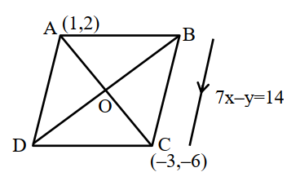
In a rhombus (which is a parallelogram), the diagonals bisect each other.
Let $O$ be the midpoint of diagonal $AC$.
$$ O = \left( \frac{1 + (-3)}{2}, \frac{2 + (-6)}{2} \right) = (-1, -2) $$
Since $O$ is also the midpoint of diagonal $BD$ connecting $B(\alpha, \beta)$ and $D(\gamma, \delta)$:
$$ \frac{\alpha + \gamma}{2} = -1 \Rightarrow \alpha + \gamma = -2 $$
$$ \frac{\beta + \delta}{2} = -2 \Rightarrow \beta + \delta = -4 $$
We need to find $|\alpha + \beta + \gamma + \delta|$:
$$ |\alpha + \beta + \gamma + \delta| = |(\alpha + \gamma) + (\beta + \delta)| $$
$$ = |-2 + (-4)| = |-6| = 6 $$
Ans. (3)
Was this solution helpful?
YesNo