Let the area of the region bounded by the curve $y=\max\{\sin x, \cos x\}$, lines $x=0$, $x=\frac{3\pi}{2}$ and the x-axis be $A$. Then, $A+A^{2}$ is equal to
Solution:
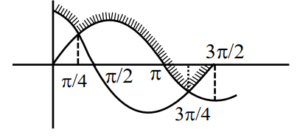
We need to calculate the area $A$ bounded by $y=\max\{\sin x, \cos x\}$ and the x-axis from $x=0$ to $x=\frac{3\pi}{2}$.
Since the area is “bounded by… and x-axis”, we integrate the absolute value of the function $|y|$ or consider the positive regions geometrically.
Split the interval $[0, \frac{3\pi}{2}]$ based on which function is greater:
1. **Interval $[0, \frac{\pi}{4}]$:**
$\cos x \ge \sin x$. Also $\cos x > 0$.
Max function is $\cos x$.
2. **Interval $[\frac{\pi}{4}, \pi]$:**
$\sin x \ge \cos x$. Also $\sin x > 0$.
Max function is $\sin x$.
3. **Interval $[\pi, \frac{5\pi}{4}]$:**
In the 3rd quadrant, both are negative.
$\sin x$ goes from $0$ to $-1/\sqrt{2}$.
$\cos x$ goes from $-1$ to $-1/\sqrt{2}$.
Here $\sin x > \cos x$ (since $\sin x$ is less negative).
However, since the region is bounded by the x-axis, we take the magnitude (area is positive).
Height = $|\max\{\sin x, \cos x\}| = |\sin x| = -\sin x$.
4. **Interval $[\frac{5\pi}{4}, \frac{3\pi}{2}]$:**
Both are negative.
$\sin x$ goes from $-1/\sqrt{2}$ to $-1$.
$\cos x$ goes from $-1/\sqrt{2}$ to $0$.
Here $\cos x > \sin x$.
Height = $|\cos x| = -\cos x$.
**Calculation:**
$$ A = \int_{0}^{\pi/4} \cos x \, dx + \int_{\pi/4}^{\pi} \sin x \, dx + \int_{\pi}^{5\pi/4} (-\sin x) \, dx + \int_{5\pi/4}^{3\pi/2} (-\cos x) \, dx $$
Step 1:
$$ [\sin x]_0^{\pi/4} = \sin(\pi/4) – 0 = \frac{1}{\sqrt{2}} $$
Step 2:
$$ [-\cos x]_{\pi/4}^{\pi} = (-\cos \pi) – (-\cos \pi/4) = 1 + \frac{1}{\sqrt{2}} $$
Step 3:
$$ [\cos x]_{\pi}^{5\pi/4} = \cos(5\pi/4) – \cos \pi = -\frac{1}{\sqrt{2}} – (-1) = 1 – \frac{1}{\sqrt{2}} $$
Step 4:
$$ [-\sin x]_{5\pi/4}^{3\pi/2} = (-\sin 3\pi/2) – (-\sin 5\pi/4) = -(-1) – (-(-\frac{1}{\sqrt{2}})) = 1 – \frac{1}{\sqrt{2}} $$
Total Area $A$:
$$ A = \frac{1}{\sqrt{2}} + \left(1 + \frac{1}{\sqrt{2}}\right) + \left(1 – \frac{1}{\sqrt{2}}\right) + \left(1 – \frac{1}{\sqrt{2}}\right) $$
$$ A = 3 $$
We need $A + A^2$:
$$ A + A^2 = 3 + 3^2 = 3 + 9 = 12 $$
Ans. 12