Question ID: #796
The vertices $B$ and $C$ of a triangle $ABC$ lie on the line $\frac{x}{1}=\frac{1-y}{-2}=\frac{z-2}{3}$. The coordinates of $A$ and $B$ are $(1, 6, 3)$ and $(4, 9, \alpha)$ respectively and $C$ is at a distance of 10 units from $B$. The area (in sq. units) of $\Delta ABC$ is:
- (1) $5\sqrt{13}$
- (2) $15\sqrt{13}$
- (3) $20\sqrt{13}$
- (4) $10\sqrt{13}$
Solution:
First, rewrite the equation of the line in standard form:
$$ \frac{x}{1} = \frac{y-1}{2} = \frac{z-2}{3} $$
Since the vertex $B(4, 9, \alpha)$ lies on this line, its coordinates must satisfy the line equation:
$$ \frac{4}{1} = \frac{9-1}{2} = \frac{\alpha-2}{3} $$
$$ 4 = \frac{8}{2} = \frac{\alpha-2}{3} $$
$$ 4 = 4 = \frac{\alpha-2}{3} \Rightarrow \alpha – 2 = 12 \Rightarrow \alpha = 14 $$
So, point $B$ is $(4, 9, 14)$.
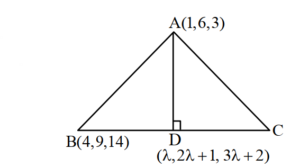
To find the area of triangle $ABC$, we treat $BC$ as the base and the perpendicular distance from $A$ to the line containing $BC$ as the height ($h$).
Given Base $BC = 10$.
Let $D$ be the foot of the perpendicular from $A(1, 6, 3)$ to the line.
The coordinates of any general point on the line can be written as $(\lambda, 2\lambda+1, 3\lambda+2)$. Let this be $D$.
The direction ratios of vector $\vec{AD}$ are:
$$ \vec{AD} = (\lambda – 1)\hat{i} + (2\lambda + 1 – 6)\hat{j} + (3\lambda + 2 – 3)\hat{k} $$
$$ \vec{AD} = (\lambda – 1)\hat{i} + (2\lambda – 5)\hat{j} + (3\lambda – 1)\hat{k} $$
Since $\vec{AD}$ is perpendicular to the line vector $\vec{b} = \hat{i} + 2\hat{j} + 3\hat{k}$, their dot product is zero:
$$ 1(\lambda – 1) + 2(2\lambda – 5) + 3(3\lambda – 1) = 0 $$
$$ \lambda – 1 + 4\lambda – 10 + 9\lambda – 3 = 0 $$
$$ 14\lambda – 14 = 0 \Rightarrow \lambda = 1 $$
Substitute $\lambda = 1$ to find the coordinates of $D$:
$$ D = (1, 2(1)+1, 3(1)+2) = (1, 3, 5) $$
Now, calculate the height $h = |\vec{AD}|$:
$$ h = \sqrt{(1-1)^2 + (3-6)^2 + (5-3)^2} $$
$$ h = \sqrt{0 + (-3)^2 + (2)^2} = \sqrt{9 + 4} = \sqrt{13} $$
Finally, calculate the area of $\Delta ABC$:
$$ \text{Area} = \frac{1}{2} \times \text{Base} \times \text{Height} $$
$$ \text{Area} = \frac{1}{2} \times 10 \times \sqrt{13} = 5\sqrt{13} $$
Ans. (1)
Was this solution helpful?
YesNo