Question ID: #723
Let the line $x=-1$ divide the area of the region $\{(x,y):1+x^{2}\le y\le3-x\}$ in the ratio $m:n$, gcd $(m,n)=1$. Then $m+n$ is equal to
- (1) 25
- (2) 28
- (3) 26
- (4) 27
Solution:
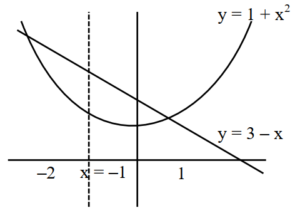
First, we find the points of intersection of the curves $y = 1+x^2$ and $y = 3-x$.
$$ 1+x^2 = 3-x $$
$$ x^2 + x – 2 = 0 $$
$$ (x+2)(x-1) = 0 $$
$$ x = -2, \quad x = 1 $$
The region is bounded between $x = -2$ and $x = 1$. The line $x = -1$ divides this area into two parts, $A_1$ (from $x=-2$ to $x=-1$) and $A_2$ (from $x=-1$ to $x=1$).
Calculating Area $A_1$:
$$ A_1 = \int_{-2}^{-1} [(3-x) – (1+x^2)] \, dx $$
$$ A_1 = \int_{-2}^{-1} (2 – x – x^2) \, dx $$
$$ A_1 = \left[ 2x – \frac{x^2}{2} – \frac{x^3}{3} \right]_{-2}^{-1} $$
Substitute upper limit $-1$:
$$ \left( -2 – \frac{1}{2} – \frac{-1}{3} \right) = -2 – \frac{1}{2} + \frac{1}{3} = \frac{-12 – 3 + 2}{6} = -\frac{13}{6} $$
Substitute lower limit $-2$:
$$ \left( -4 – \frac{4}{2} – \frac{-8}{3} \right) = -4 – 2 + \frac{8}{3} = -6 + \frac{8}{3} = -\frac{10}{3} = -\frac{20}{6} $$
$$ A_1 = \left( -\frac{13}{6} \right) – \left( -\frac{20}{6} \right) = \frac{7}{6} $$
Calculating Area $A_2$:
$$ A_2 = \int_{-1}^{1} (2 – x – x^2) \, dx $$
$$ A_2 = \left[ 2x – \frac{x^2}{2} – \frac{x^3}{3} \right]_{-1}^{1} $$
Substitute upper limit $1$:
$$ \left( 2 – \frac{1}{2} – \frac{1}{3} \right) = \frac{12 – 3 – 2}{6} = \frac{7}{6} $$
Substitute lower limit $-1$:
$$ \left( -2 – \frac{1}{2} + \frac{1}{3} \right) = -\frac{13}{6} $$
$$ A_2 = \frac{7}{6} – \left( -\frac{13}{6} \right) = \frac{20}{6} $$
The ratio $m:n$ is given by $A_2 : A_1$
Ratio = $\frac{20}{6} : \frac{7}{6} = 20 : 7$.
Here $m = 20$ and $n = 7$ (or vice versa).
$\text{gcd}(20, 7) = 1$.
We need $m+n$:
$$ m + n = 20 + 7 = 27 $$
Ans. (4)
Was this solution helpful?
YesNo