Question ID: #720
Let $\vec{AB}=2\hat{i}+4\hat{j}-5\hat{k}$ and $\vec{AD}=\hat{i}+2\hat{j}+\lambda \hat{k}$, $\lambda\in\mathbb{R}$. Let the projection of the vector $\vec{v}=\hat{i}+\hat{j}+\hat{k}$ on the diagonal $\vec{AC}$ of the parallelogram $ABCD$ be of length one unit. If $\alpha, \beta$, where $\alpha>\beta$, be the roots of the equation $\lambda^{2}x^{2}-6\lambda x+5=0$, then $2\alpha-\beta$ is equal to
- (1) 1
- (2) 4
- (3) 3
- (4) 6
Solution:
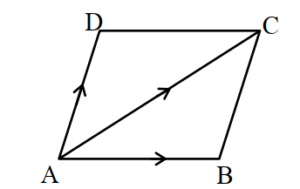
In a parallelogram, the diagonal $\vec{AC}$ is the sum of adjacent sides $\vec{AB}$ and $\vec{AD}$.
$$ \vec{AC} = \vec{AB} + \vec{AD} $$
$$ \vec{AC} = (2\hat{i}+4\hat{j}-5\hat{k}) + (\hat{i}+2\hat{j}+\lambda\hat{k}) $$
$$ \vec{AC} = 3\hat{i} + 6\hat{j} + (\lambda-5)\hat{k} $$
The projection of vector $\vec{v}$ on $\vec{AC}$ is given by:
$$ \left| \frac{\vec{v} \cdot \vec{AC}}{|\vec{AC}|} \right| = 1 $$
Calculating the dot product $\vec{v} \cdot \vec{AC}$:
$$ \vec{v} \cdot \vec{AC} = (1)(3) + (1)(6) + (1)(\lambda-5) = 3 + 6 + \lambda – 5 = \lambda + 4 $$
Calculating the magnitude $|\vec{AC}|$:
$$ |\vec{AC}| = \sqrt{3^2 + 6^2 + (\lambda-5)^2} = \sqrt{9 + 36 + (\lambda-5)^2} = \sqrt{45 + (\lambda-5)^2} $$
Substituting these into the projection formula:
$$ \frac{|\lambda + 4|}{\sqrt{45 + (\lambda-5)^2}} = 1 $$
Squaring both sides:
$$ (\lambda + 4)^2 = 45 + (\lambda – 5)^2 $$
$$ \lambda^2 + 8\lambda + 16 = 45 + \lambda^2 – 10\lambda + 25 $$
$$ 8\lambda + 10\lambda = 70 – 16 $$
$$ 18\lambda = 54 \Rightarrow \lambda = 3 $$
Now, substitute $\lambda = 3$ into the given quadratic equation $\lambda^{2}x^{2}-6\lambda x+5=0$:
$$ 9x^2 – 18x + 5 = 0 $$
Solving for $x$:
$$ 9x^2 – 15x – 3x + 5 = 0 $$
$$ 3x(3x-5) – 1(3x-5) = 0 $$
$$ (3x-1)(3x-5) = 0 $$
$$ x = \frac{1}{3}, \frac{5}{3} $$
Given $\alpha > \beta$, we have:
$$ \alpha = \frac{5}{3}, \quad \beta = \frac{1}{3} $$
Finding the value of $2\alpha – \beta$:
$$ 2\alpha – \beta = 2\left(\frac{5}{3}\right) – \frac{1}{3} $$
$$ = \frac{10}{3} – \frac{1}{3} = \frac{9}{3} = 3 $$
Ans. (3)
Was this solution helpful?
YesNo