Question ID: #686
Let $\alpha$ and $\beta$ be the roots of equation $x^{2}+2ax+(3a+10)=0$ such that $\alpha \lt 1 \lt \beta$. Then the set of all possible values of $a$ is:
- (1) $\left(-\infty,\frac{-11}{5}\right)\cup(5,\infty)$
- (2) $(-\infty,-2)\cup(5,\infty)$
- (3) $(-\infty,-3)$
- (4) $\left(-\infty,\frac{-11}{5}\right)$
Solution:
Let $f(x) = x^{2}+2ax+(3a+10)$.
Given that the roots $\alpha$ and $\beta$ satisfy the condition $\alpha \lt 1 \lt \beta$.
Since the coefficient of $x^2$ is $1 \gt 0$, the parabola opens upwards. For a number to lie strictly between the roots of an upward-opening parabola, the value of the function at that number must be strictly less than 0.
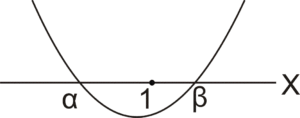
Therefore, the condition is $f(1) \lt 0$.
$$f(1) = (1)^{2} + 2a(1) + (3a+10) \lt 0$$
$$1 + 2a + 3a + 10 \lt 0$$
$$5a + 11 \lt 0$$
$$5a \lt -11$$
$$a \lt -\frac{11}{5}$$
This means $a \in \left(-\infty, -\frac{11}{5}\right)$.
Ans. (4)
Was this solution helpful?
YesNo