Question ID: #681
Let the line $L$ pass through the point $(-3, 5, 2)$ and make equal angles with the positive coordinate axes. If the distance of $L$ from the point $(-2, r, 1)$ is $\sqrt{\frac{14}{3}}$, then the sum of all possible values of $r$ is:
- (1) 12
- (2) 16
- (3) 6
- (4) 10
Solution:
Since the line makes equal angles with the positive coordinate axes, its direction cosines satisfy $\cos^2\alpha + \cos^2\alpha + \cos^2\alpha = 1$, which gives $\cos\alpha = \frac{1}{\sqrt{3}}$.
The direction ratios are proportional to $(1, 1, 1)$.
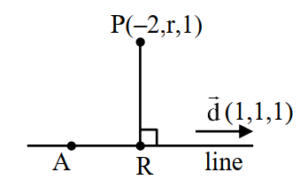
Equation of the line passing through $(-3, 5, 2)$ with direction ratios $(1, 1, 1)$ is:
$$\frac{x+3}{1} = \frac{y-5}{1} = \frac{z-2}{1} = \lambda$$
Let $R$ be a general point on the line: $R(\lambda-3, \lambda+5, \lambda+2)$.
Let the given point be $P(-2, r, 1)$.
The distance $PR$ is the perpendicular distance if $\vec{PR}$ is perpendicular to the direction vector of the line $\vec{d} = (1, 1, 1)$.
Vector $\vec{PR} = (\lambda-3 – (-2))\hat{i} + (\lambda+5 – r)\hat{j} + (\lambda+2 – 1)\hat{k}$
$\vec{PR} = (\lambda-1)\hat{i} + (\lambda+5-r)\hat{j} + (\lambda+1)\hat{k}$
Condition for perpendicularity $\vec{PR} \cdot \vec{d} = 0$:
$$(\lambda-1)(1) + (\lambda+5-r)(1) + (\lambda+1)(1) = 0$$
$$3\lambda + 5 – r = 0 \Rightarrow \lambda = \frac{r-5}{3}$$
Given distance $PR = \sqrt{\frac{14}{3}}$, so $PR^2 = \frac{14}{3}$:
$$(\lambda-1)^2 + (\lambda+5-r)^2 + (\lambda+1)^2 = \frac{14}{3}$$
Substitute $\lambda = \frac{r-5}{3}$:
$$\left(\frac{r-5}{3}-1\right)^2 + \left(\frac{r-5}{3}+5-r\right)^2 + \left(\frac{r-5}{3}+1\right)^2 = \frac{14}{3}$$
$$\left(\frac{r-8}{3}\right)^2 + \left(\frac{10-2r}{3}\right)^2 + \left(\frac{r-2}{3}\right)^2 = \frac{14}{3}$$
Multiply by 9:
$$(r-8)^2 + (10-2r)^2 + (r-2)^2 = 14 \times 3 = 42$$
$$(r^2 – 16r + 64) + (100 – 40r + 4r^2) + (r^2 – 4r + 4) = 42$$
$$6r^2 – 60r + 168 = 42$$
$$6r^2 – 60r + 126 = 0$$
Divide by 6:
$$r^2 – 10r + 21 = 0$$
$$(r-3)(r-7) = 0$$
So, $r = 3$ or $r = 7$.
Sum of all possible values of $r = 3 + 7 = 10$.
Ans. (4)
Was this solution helpful?
YesNo