Let PQ and MN be two straight lines touching the circle $x^{2}+y^{2}-4x-6y-3=0$ at the points A and B respectively. Let O be the centre of the circle and $\angle AOB=\pi/3.$ Then the locus of the point of intersection of the lines PQ and MN is:
- (1) $3(x^{2}+y^{2})-18x-12y+25=0$
- (2) $x^{2}+y^{2}-12x-18y-25=0$
- (3) $x^{2}+y^{2}-18x-12y-25=0$
- (4) $3(x^{2}+y^{2})-12x-18y-25=0$
Solution:
Equation of circle: $x^2 + y^2 – 4x – 6y – 3 = 0$.
Center $C(2, 3)$.
Radius $r = \sqrt{g^2 + f^2 – c} = \sqrt{2^2 + 3^2 – (-3)} = \sqrt{4 + 9 + 3} = \sqrt{16} = 4$.
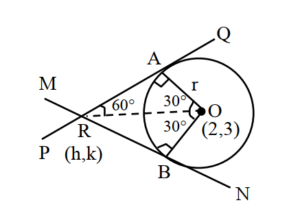
Let the intersection point of tangents PQ and MN be $R(h, k)$.
In the diagram, $OA$ and $OB$ are radii perpendicular to the tangents.
We are given $\angle AOB = 60^\circ$.
By symmetry, the line joining the center $O$ to the external point $R$ bisects $\angle AOB$.
Therefore, in right-angled triangle $\Delta OAR$, $\angle AOR = 30^\circ$.
Using trigonometry in $\Delta OAR$:
$$\cos 30^\circ = \frac{\text{Base}}{\text{Hypotenuse}} = \frac{OA}{OR}$$
$$\frac{\sqrt{3}}{2} = \frac{4}{OR}$$
$$OR = \frac{8}{\sqrt{3}}$$
Now, use the distance formula for $OR$ between $O(2, 3)$ and $R(h, k)$:
$$OR^2 = (h-2)^2 + (k-3)^2$$
Substitute $OR^2 = \frac{64}{3}$:
$$(h-2)^2 + (k-3)^2 = \frac{64}{3}$$
$$3[(h^2 – 4h + 4) + (k^2 – 6k + 9)] = 64$$
$$3[h^2 + k^2 – 4h – 6k + 13] = 64$$
$$3(h^2 + k^2) – 12h – 18k + 39 – 64 = 0$$
$$3(h^2 + k^2) – 12h – 18k – 25 = 0$$
Replacing $(h, k)$ with $(x, y)$, the locus is:
$$3(x^2 + y^2) – 12x – 18y – 25 = 0$$
Ans. (4)