Question ID: #564
Let $P$ be the foot of the perpendicular from the point $(1, 2, 2)$ on the line $L: \frac{x-1}{1}=\frac{y+1}{-1}=\frac{z-2}{2}$. Let the line $\vec{r}=(-\hat{i}+\hat{j}-2\hat{k})+\lambda(\hat{i}-\hat{j}+\hat{k})$, $\lambda \in R$ intersect the line $L$ at $Q$. Then $2(PQ)^{2}$ is equal to:
- (1) 27
- (2) 25
- (3) 29
- (4) 19
Solution:
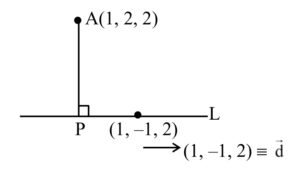
Let $A = (1, 2, 2)$. The coordinates of a general point on the line $L$ can be written as:
$$ P(\mu) = (\mu + 1, -\mu – 1, 2\mu + 2) $$
The direction vector of $L$ is $\vec{d} = (1, -1, 2)$.
Since $P$ is the foot of the perpendicular from $A$ to $L$, the vector $\vec{AP}$ is perpendicular to $\vec{d}$.
$$ \vec{AP} = (\mu + 1 – 1, -\mu – 1 – 2, 2\mu + 2 – 2) = (\mu, -\mu – 3, 2\mu) $$
Calculating the dot product $\vec{AP} \cdot \vec{d} = 0$:
$$ 1(\mu) – 1(-\mu – 3) + 2(2\mu) = 0 $$
$$ \mu + \mu + 3 + 4\mu = 0 $$
$$ 6\mu = -3 \Rightarrow \mu = -\frac{1}{2} $$
Substituting $\mu = -\frac{1}{2}$ into $P(\mu)$ gives the coordinates of $P$:
$$ P\left(1 – \frac{1}{2}, -1 + \frac{1}{2}, 2 – 1\right) = P\left(\frac{1}{2}, -\frac{1}{2}, 1\right) $$
Now we find the intersection point $Q$ of line $L$ and the second line given by $\vec{r} = (-1, 1, -2) + \lambda(1, -1, 1)$.
General point on the second line: $(-1 + \lambda, 1 – \lambda, -2 + \lambda)$.
General point on line $L$: $(\mu + 1, -\mu – 1, 2\mu + 2)$.
Equating coordinates:
1) $\mu + 1 = -1 + \lambda \Rightarrow \lambda – \mu = 2$
2) $2\mu + 2 = -2 + \lambda \Rightarrow \lambda – 2\mu = 4$
Subtracting (2) from (1):
$$ (\lambda – \mu) – (\lambda – 2\mu) = 2 – 4 $$
$$ \mu = -2 $$
Substituting $\mu = -2$ into the general point of line $L$ to get $Q$:
$$ Q = (-2 + 1, -(-2) – 1, 2(-2) + 2) $$
$$ Q = (-1, 1, -2) $$
Now we calculate $(PQ)^2$:
$$ PQ^2 = \left(-1 – \frac{1}{2}\right)^2 + \left(1 – \left(-\frac{1}{2}\right)\right)^2 + (-2 – 1)^2 $$
$$ PQ^2 = \left(-\frac{3}{2}\right)^2 + \left(\frac{3}{2}\right)^2 + (-3)^2 $$
$$ PQ^2 = \frac{9}{4} + \frac{9}{4} + 9 = \frac{18}{4} + 9 = \frac{9}{2} + 9 = \frac{27}{2} $$
Finally, we need $2(PQ)^2$:
$$ 2(PQ)^2 = 2 \times \frac{27}{2} = 27 $$
Ans. (1)
Was this solution helpful?
YesNo