If the domain of the function $ \log_{5}(18x – x^2 – 77)$ is $(\alpha, \beta)$ and the domain of the function $ \log_{(x-1)}\left(\frac{2x^2 + 3x – 2}{x^2 – 3x – 4}\right)$ is $(\gamma, \delta)$, then $\alpha^2 + \beta^2 + \gamma^2$ is equal to:
- (1) 195
- (2) 174
- (3) 186
- (4) 179
Solution:
For $f_1(x)$ defined by $\log_{5}(18x – x^2 – 77)$:
The argument must be positive:
$18x – x^2 – 77 > 0$
$x^2 – 18x + 77 < 0$
$(x – 7)(x – 11) < 0$
$x \in (7, 11)$
Comparing with $(\alpha, \beta)$, we get $\alpha = 7, \beta = 11$.
For $f_2(x)$ defined by $\log_{(x-1)}\left(\frac{2x^2 + 3x – 2}{x^2 – 3x – 4}\right)$:
Base condition: $x – 1 > 0$ and $x – 1 \neq 1 \Rightarrow x > 1$ and $x \neq 2$.
Argument condition: $\frac{2x^2 + 3x – 2}{x^2 – 3x – 4} > 0$
$\frac{(2x – 1)(x + 2)}{(x – 4)(x + 1)} > 0$
Critical points are $-2, -1, \frac{1}{2}, 4$.
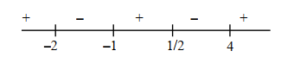
Sign scheme for the argument: $(-\infty, -2) \cup (-1, \frac{1}{2}) \cup (4, \infty)$.
Combining with the base condition ($x > 1, x \neq 2$), the common region is $(4, \infty)$.
Thus, the domain is $(4, \infty)$, implying $\gamma = 4$.
Final Calculation:
$\alpha^2 + \beta^2 + \gamma^2 = 7^2 + 11^2 + 4^2$
$= 49 + 121 + 16$
$= 186$
Ans. (3)