Question ID: #521
Let the ellipse $E_{1}: \frac{x^{2}}{a^{2}} + \frac{y^{2}}{b^{2}} = 1$ ($a>b$) and $E_{2}: \frac{x^{2}}{A^{2}} + \frac{y^{2}}{B^{2}} = 1$ ($A\lt B$) have same eccentricity $\frac{1}{\sqrt{3}}$. Let the product of their lengths of latus rectums be $\frac{32}{\sqrt{3}}$ and the distance between the foci of $E_{1}$ be 4. If $E_{1}$ and $E_{2}$ meet at $A, B, C$ and $D$, then the area of the quadrilateral $ABCD$ equals:
- (1) $6\sqrt{6}$
- (2) $\frac{18\sqrt{6}}{5}$
- (3) $\frac{12\sqrt{6}}{5}$
- (4) $\frac{24\sqrt{6}}{5}$
Solution:
Given eccentricity $e = \frac{1}{\sqrt{3}}$.
For ellipse $E_1$ ($a>b$):
Distance between foci is $2ae = 4 \Rightarrow ae = 2$.
Substitute $e$: $a \left(\frac{1}{\sqrt{3}}\right) = 2 \Rightarrow a = 2\sqrt{3}$.
Now, $a^2 = 12$.
Using $b^2 = a^2(1-e^2)$:
$b^2 = 12 \left(1 – \frac{1}{3}\right) = 12 \left(\frac{2}{3}\right) = 8$.
So, $E_1$ is $\frac{x^2}{12} + \frac{y^2}{8} = 1$.
Length of Latus Rectum of $E_1$ ($LR_1$) is $\frac{2b^2}{a} = \frac{2(8)}{2\sqrt{3}} = \frac{8}{\sqrt{3}}$.
Given product of latus rectums $LR_1 \times LR_2 = \frac{32}{\sqrt{3}}$.
$\frac{8}{\sqrt{3}} \times LR_2 = \frac{32}{\sqrt{3}} \Rightarrow LR_2 = 4$.
For ellipse $E_2$ ($A \lt B$), the major axis is along y-axis.
$LR_2 = \frac{2A^2}{B} = 4 \Rightarrow A^2 = 2B$.
Also, for vertical ellipse, $e^2 = 1 – \frac{A^2}{B^2}$.
$\frac{1}{3} = 1 – \frac{2B}{B^2} \Rightarrow \frac{1}{3} = 1 – \frac{2}{B}$.
$\frac{2}{B} = 1 – \frac{1}{3} = \frac{2}{3} \Rightarrow B = 3$.
Then $A^2 = 2(3) = 6$.
So, $E_2$ is $\frac{x^2}{6} + \frac{y^2}{9} = 1$.
Now, find the points of intersection by solving the two equations:
(1) $\frac{x^2}{12} + \frac{y^2}{8} = 1 \Rightarrow 2x^2 + 3y^2 = 24$.
(2) $\frac{x^2}{6} + \frac{y^2}{9} = 1 \Rightarrow 3x^2 + 2y^2 = 18$.
Multiply (2) by 2: $6x^2 + 4y^2 = 36$.
Multiply (1) by 3: $6x^2 + 9y^2 = 72$.
Subtracting: $5y^2 = 36 \Rightarrow y^2 = \frac{36}{5} \Rightarrow y = \pm \frac{6}{\sqrt{5}}$.
Substitute $y^2$ in (2): $3x^2 + 2(\frac{36}{5}) = 18 \Rightarrow 3x^2 = 18 – \frac{72}{5} = \frac{18}{5}$.
$x^2 = \frac{6}{5} \Rightarrow x = \pm \frac{\sqrt{6}}{\sqrt{5}}$.
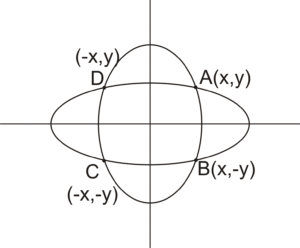
The quadrilateral formed is a rectangle with vertices $(\pm \frac{\sqrt{6}}{\sqrt{5}}, \pm \frac{6}{\sqrt{5}})$.
Area $= (2|x|) \times (2|y|) = 4 |xy|$.
Area $= 4 \left( \frac{\sqrt{6}}{\sqrt{5}} \right) \left( \frac{6}{\sqrt{5}} \right) = \frac{24\sqrt{6}}{5}$.
Ans. (4)
Was this solution helpful?
YesNo