Question ID: #503
Let the line $x+y=1$ meet the circle $x^{2}+y^{2}=4$ at the points $A$ and $B$. If the line perpendicular to $AB$ and passing through the midpoint of the chord $AB$ intersects the circle at $C$ and $D$, then the area of the quadrilateral $ADBC$ is equal to:
- (1) $3\sqrt{7}$
- (2) $2\sqrt{14}$
- (3) $5\sqrt{7}$
- (4) $\sqrt{14}$
Solution:
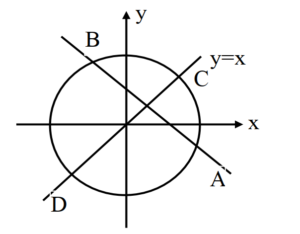
The equation of the given circle is $x^{2}+y^{2}=4$. Center $O(0,0)$ and Radius $R=2$.
The equation of the chord $AB$ is $x+y=1$.
The line perpendicular to $AB$ and passing through the midpoint of $AB$ passes through the center $(0,0)$.
Slope of $AB$ is $-1$. Thus, the slope of the perpendicular line $CD$ is $1$.
Equation of line $CD$ is $y=x$.
Solving $y=x$ with the circle $x^{2}+y^{2}=4$:
$2x^2 = 4 \Rightarrow x^2 = 2 \Rightarrow x = \pm\sqrt{2}$.
So, the points $C$ and $D$ are $(\sqrt{2}, \sqrt{2})$ and $(-\sqrt{2}, -\sqrt{2})$.
Length of diagonal $CD = \sqrt{(\sqrt{2}-(-\sqrt{2}))^2 + (\sqrt{2}-(-\sqrt{2}))^2} = \sqrt{(2\sqrt{2})^2 + (2\sqrt{2})^2} = \sqrt{8+8} = 4$. (Since $CD$ is a diameter).
Now, find the intersection points $A$ and $B$ by solving $x+y=1$ and $x^{2}+y^{2}=4$.
Substitute $y=1-x$ into the circle equation:
$x^2 + (1-x)^2 = 4$
$x^2 + 1 – 2x + x^2 = 4$
$2x^2 – 2x – 3 = 0$
Roots are $x = \frac{2 \pm \sqrt{4 – 4(2)(-3)}}{4} = \frac{2 \pm \sqrt{28}}{4} = \frac{1 \pm \sqrt{7}}{2}$.
Let $A = (\frac{1+\sqrt{7}}{2}, \frac{1-\sqrt{7}}{2})$ and $B = (\frac{1-\sqrt{7}}{2}, \frac{1+\sqrt{7}}{2})$.
Length of chord $AB = \sqrt{(x_2-x_1)^2 + (y_2-y_1)^2}$.
Difference in x-coordinates: $\frac{1-\sqrt{7}}{2} – \frac{1+\sqrt{7}}{2} = -\sqrt{7}$.
Difference in y-coordinates: $\frac{1+\sqrt{7}}{2} – \frac{1-\sqrt{7}}{2} = \sqrt{7}$.
$AB = \sqrt{(-\sqrt{7})^2 + (\sqrt{7})^2} = \sqrt{7+7} = \sqrt{14}$.
Since the diagonals $AB$ and $CD$ are perpendicular, the area of quadrilateral $ADBC$ is:
Area $= \frac{1}{2} \times AB \times CD$
Area $= \frac{1}{2} \times \sqrt{14} \times 4$
Area $= 2\sqrt{14}$
Ans. (2)
Was this solution helpful?
YesNo