Question ID: #492
Two equal sides of an isosceles triangle are along $-x+2y=4$ and $x+y=4$. If $m$ is the slope of its third side, then the sum of all possible distinct values of $m$, is:
- (1) -6
- (2) 12
- (3) 6
- (4) $-2\sqrt{10}$
Solution:
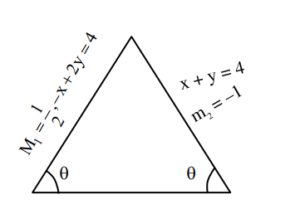
Let the slopes of the equal sides be $m_1$ and $m_2$.
Line 1: $-x+2y=4 \Rightarrow 2y = x+4 \Rightarrow y = \frac{1}{2}x + 2$. So $m_1 = \frac{1}{2}$.
Line 2: $x+y=4 \Rightarrow y = -x + 4$. So $m_2 = -1$.
Let the slope of the third side be $m$.
Since the triangle is isosceles, the angle between the third side ($m$) and the first equal side ($m_1$) must be equal to the angle between the third side ($m$) and the second equal side ($m_2$).
$$\left| \frac{m – m_1}{1 + m m_1} \right| = \left| \frac{m – m_2}{1 + m m_2} \right|$$
Substituting values:
$$\left| \frac{m – \frac{1}{2}}{1 + \frac{m}{2}} \right| = \left| \frac{m – (-1)}{1 + m(-1)} \right|$$
$$\left| \frac{\frac{2m-1}{2}}{\frac{2+m}{2}} \right| = \left| \frac{m+1}{1-m} \right|$$
$$\frac{2m-1}{m+2} = \pm \frac{m+1}{1-m}$$
Case 1 (+):
$$(2m-1)(1-m) = (m+1)(m+2)$$
$$2m – 2m^2 – 1 + m = m^2 + 3m + 2$$
$$-2m^2 + 3m – 1 = m^2 + 3m + 2$$
$$3m^2 + 3 = 0 \Rightarrow m^2 = -1$$ (No real solution)
Case 2 (-):
$$\frac{2m-1}{m+2} = – \frac{m+1}{1-m} = \frac{m+1}{m-1}$$
$$(2m-1)(m-1) = (m+2)(m+1)$$
$$2m^2 – 2m – m + 1 = m^2 + 3m + 2$$
$$2m^2 – 3m + 1 = m^2 + 3m + 2$$
$$m^2 – 6m – 1 = 0$$
This quadratic equation gives two real values for $m$.
The sum of the roots is given by $-\frac{\text{coefficient of } m}{\text{coefficient of } m^2}$.
$$Sum = -\frac{-6}{1} = 6$$
Ans. (3)
Was this solution helpful?
YesNo