Question ID: #481
The square of the distance of the point $P\left(\frac{15}{7}, \frac{32}{7}, 7\right)$ from the line $\frac{x+1}{3}=\frac{y+3}{5}=\frac{z+5}{7}$ measured in the direction of the vector $\hat{i}+4\hat{j}+7\hat{k}$ is:
- (1) 54
- (2) 41
- (3) 66
- (4) 44
Solution:
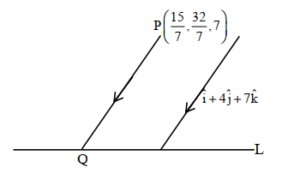
Let the given line be $L: \frac{x+1}{3}=\frac{y+3}{5}=\frac{z+5}{7}$.
Let $Q$ be the point on the line $L$ such that $PQ$ is parallel to the vector $\vec{v} = \hat{i}+4\hat{j}+7\hat{k}$.
The equation of the line passing through $P\left(\frac{15}{7}, \frac{32}{7}, 7\right)$ and parallel to $\vec{v}$ is:
$$\frac{x-\frac{15}{7}}{1} = \frac{y-\frac{32}{7}}{4} = \frac{z-7}{7} = \lambda$$
Coordinates of a general point $Q$ on this line are:
$$Q\left( \lambda + \frac{15}{7}, 4\lambda + \frac{32}{7}, 7\lambda + 7 \right)$$
Since $Q$ lies on line $L$, these coordinates must satisfy the equation of $L$:
$$\frac{(\lambda + \frac{15}{7}) + 1}{3} = \frac{(4\lambda + \frac{32}{7}) + 3}{5} = \frac{(7\lambda + 7) + 5}{7}$$
Taking the first and last terms:
$$\frac{\lambda + \frac{22}{7}}{3} = \frac{7\lambda + 12}{7}$$
$$7\left( \lambda + \frac{22}{7} \right) = 3(7\lambda + 12)$$
$$7\lambda + 22 = 21\lambda + 36$$
$$22 – 36 = 21\lambda – 7\lambda$$
$$-14 = 14\lambda \Rightarrow \lambda = -1$$
Now, substitute $\lambda = -1$ to find point $Q$:
$$Q\left( -1 + \frac{15}{7}, -4 + \frac{32}{7}, -7 + 7 \right)$$
$$Q\left( \frac{8}{7}, \frac{4}{7}, 0 \right)$$
The distance $PQ$ is given by the distance formula:
$$PQ^2 = \left( \frac{15}{7} – \frac{8}{7} \right)^2 + \left( \frac{32}{7} – \frac{4}{7} \right)^2 + (7 – 0)^2$$
$$PQ^2 = \left( \frac{7}{7} \right)^2 + \left( \frac{28}{7} \right)^2 + 7^2$$
$$PQ^2 = (1)^2 + (4)^2 + 49$$
$$PQ^2 = 1 + 16 + 49 = 66$$
Ans. (3)
Was this solution helpful?
YesNo