Let $f(x) = \begin{cases} 3x, & x < 0 \\ \min\{1+x+[x], x+2[x]\}, & 0 \le x \le 2 \\ 5, & x > 2 \end{cases}$
where $[.]$ denotes greatest integer function. If $\alpha$ and $\beta$ are the number of points, where $f$ is not continuous and is not differentiable, respectively, then $\alpha + \beta$ equals……
Solution:
We analyze the function $f(x)$ in the interval $0 \le x \le 2$ by breaking it at integer points where $[x]$ changes.
Case 1: $0 \le x < 1$
Here $[x] = 0$.
$$ f(x) = \min\{1+x+0, x+2(0)\} = \min\{1+x, x\} $$
Since $x < x+1$ for all real $x$,
$$ f(x) = x $$
Case 2: $1 \le x < 2$
Here $[x] = 1$.
$$ f(x) = \min\{1+x+1, x+2(1)\} = \min\{x+2, x+2\} $$
$$ f(x) = x+2 $$
Case 3: $x = 2$
Here $[x] = 2$.
$$ f(x) = \min\{1+2+2, 2+2(2)\} = \min\{5, 6\} $$
$$ f(x) = 5 $$
So, the explicit definition of the function is:
$$ f(x) = \begin{cases} 3x, & x < 0 \\ x, & 0 \le x < 1 \\ x+2, & 1 \le x < 2 \\ 5, & x \ge 2 \end{cases} $$
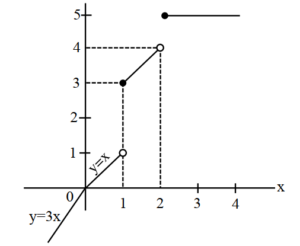
Step 1: Check Continuity
At $x = 0$:
LHL ($x \to 0^-$) $= 3(0) = 0$.
RHL ($x \to 0^+$) $= 0$.
$f(0) = 0$.
$\Rightarrow$ Continuous at $x=0$.
At $x = 1$:
LHL ($x \to 1^-$) $= 1$.
RHL ($x \to 1^+$) $= 1+2 = 3$.
LHL $\ne$ RHL.
$\Rightarrow$ Discontinuous at $x=1$.
At $x = 2$:
LHL ($x \to 2^-$) $= 2+2 = 4$.
RHL ($x \to 2^+$) $= 5$.
LHL $\ne$ RHL.
$\Rightarrow$ Discontinuous at $x=2$.
Number of points of discontinuity $\alpha = 2$ (at $x=1, 2$).
Step 2: Check Differentiability
A function is not differentiable where it is discontinuous. So, non-differentiable at $x=1, 2$.
Now check points where it is continuous (i.e., $x=0$).
At $x = 0$:
LHD $= \frac{d}{dx}(3x) = 3$.
RHD $= \frac{d}{dx}(x) = 1$.
LHD $\ne$ RHD.
$\Rightarrow$ Not Differentiable at $x=0$.
Number of points of non-differentiability $\beta = 3$ (at $x=0, 1, 2$).
Step 3: Calculate Sum
$$ \alpha + \beta = 2 + 3 = 5 $$
Ans. 5