Question ID: #441
If the image of the point $P(4, 4, 3)$ in the line $\frac{x-1}{2} = \frac{y-2}{1} = \frac{z-1}{3}$ is $(\alpha, \beta, \gamma)$, then $\alpha + \beta + \gamma$ is equal to
- (1) 9
- (2) 12
- (3) 8
- (4) 7
Solution:
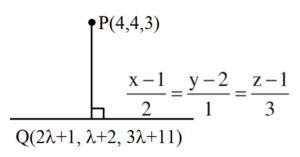
Let the general point on the line be $Q(2\lambda + 1, \lambda + 2, 3\lambda + 1)$.
The direction ratios of the line are $\vec{d} = (2, 1, 3)$.
Let $Q$ be the foot of the perpendicular from $P(4, 4, 3)$ to the line.
Vector $\vec{PQ} = (2\lambda + 1 – 4, \lambda + 2 – 4, 3\lambda + 1 – 3) = (2\lambda – 3, \lambda – 2, 3\lambda – 2)$.
Since $\vec{PQ} \perp \vec{d}$:
$2(2\lambda – 3) + 1(\lambda – 2) + 3(3\lambda – 2) = 0$
$4\lambda – 6 + \lambda – 2 + 9\lambda – 6 = 0$
$14\lambda – 14 = 0 \Rightarrow \lambda = 1$.
Coordinates of foot of perpendicular $Q$:
$Q = (2(1)+1, 1+2, 3(1)+1) = (3, 3, 4)$.
Let the image be $R(\alpha, \beta, \gamma)$.
$Q$ is the midpoint of $PR$.
$\frac{\alpha + 4}{2} = 3 \Rightarrow \alpha + 4 = 6 \Rightarrow \alpha = 2$
$\frac{\beta + 4}{2} = 3 \Rightarrow \beta + 4 = 6 \Rightarrow \beta = 2$
$\frac{\gamma + 3}{2} = 4 \Rightarrow \gamma + 3 = 8 \Rightarrow \gamma = 5$
We need $\alpha + \beta + \gamma = 2 + 2 + 5 = 9$.
Ans. (1)
Was this solution helpful?
YesNo