A board has 16 squares as shown in the figure.
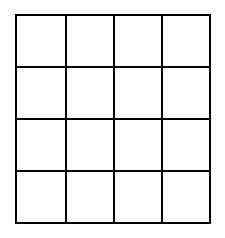
Out of these 16 squares, two squares are chosen at random. The probability that they have no side in common is:
- (1) $\frac{4}{5}$
- (2) $\frac{7}{10}$
- (3) $\frac{3}{5}$
- (4) $\frac{23}{30}$
Solution:
Total number of squares on the board $n = 16$.
We need to choose two squares at random.
The total number of ways to choose 2 squares out of 16 is:
$$n(S) = {}^{16}C_2 = \frac{16 \times 15}{2} = 120$$
Let $E$ be the event that the two squares have a side in common.
Two squares have a side in common if they are adjacent horizontally or vertically.
**Number of Horizontal Adjacent Pairs:**
In any row of 4 squares, there are 3 adjacent pairs (squares 1-2, 2-3, 3-4).
Since there are 4 rows:
$$3 \times 4 = 12 \text{ pairs}$$
**Number of Vertical Adjacent Pairs:**
In any column of 4 squares, there are 3 adjacent pairs.
Since there are 4 columns:
$$3 \times 4 = 12 \text{ pairs}$$
Total number of favorable outcomes for having a common side ($E$):
$$n(E) = 12 + 12 = 24$$
Probability that they have a side in common:
$$P(E) = \frac{24}{120} = \frac{1}{5}$$
The required probability is that they have **no** side in common ($E’$):
$$P(E’) = 1 – P(E)$$
$$P(E’) = 1 – \frac{1}{5} = \frac{4}{5}$$
Ans. (1)