Let $L_1: \frac{x-1}{3} = \frac{y-1}{-1} = \frac{z+1}{0}$ and $L_2: \frac{x-2}{2} = \frac{y}{0} = \frac{z+4}{\alpha}$, $\alpha \in R$, be two lines which intersect at the point B. If P is the foot of perpendicular from the point $A(1, 1, -1)$ on $L_2$, then the value of $26\alpha(PB)^2$ is:
Solution:
First, we find the intersection point B.
$$
\begin{aligned}
\text{General point on } L_1 &= (3\lambda + 1, -\lambda + 1, -1) \\
\text{General point on } L_2 &= (2\mu + 2, 0, \alpha\mu – 4)
\end{aligned}
$$
Comparing coordinates for intersection:
$$
\begin{aligned}
y\text{-coordinate}: -\lambda + 1 &= 0 \Rightarrow \lambda = 1 \\
z\text{-coordinate}: -1 &= \alpha\mu – 4 \Rightarrow \alpha\mu = 3 \\
x\text{-coordinate}: 3(1) + 1 &= 2\mu + 2 \Rightarrow 4 = 2\mu + 2 \Rightarrow \mu = 1
\end{aligned}
$$
Substituting $\mu=1$ in $\alpha\mu=3$, we get $\alpha = 3$.
Coordinates of B (using $\lambda=1$):
$$ B(4, 0, -1) $$
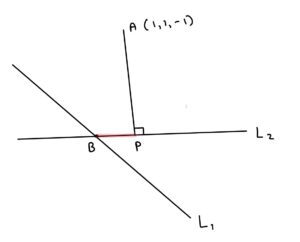
Now, P is the foot of perpendicular from $A(1, 1, -1)$ on $L_2$ (where $\alpha=3$).
Let coordinates of P be $(2k + 2, 0, 3k – 4)$.
$$
\begin{aligned}
\text{Direction ratios of AP} &= \langle 2k+1, -1, 3k-3 \rangle \\
\text{Direction ratios of } L_2 &= \langle 2, 0, 3 \rangle
\end{aligned}
$$
Since $AP \perp L_2$, their dot product is zero:
$$
\begin{aligned}
2(2k+1) + 0 + 3(3k-3) &= 0 \\
4k + 2 + 9k – 9 &= 0 \\
13k &= 7 \Rightarrow k = \frac{7}{13}
\end{aligned}
$$
Now, finding coordinates of P using $k = \frac{7}{13}$:
$$
\begin{aligned}
P &= \left( 2\left(\frac{7}{13}\right) + 2, 0, 3\left(\frac{7}{13}\right) – 4 \right) \\
&= \left( \frac{14+26}{13}, 0, \frac{21-52}{13} \right) \\
&= \left( \frac{40}{13}, 0, \frac{-31}{13} \right)
\end{aligned}
$$
Finding distance $PB^2$ between $P(\frac{40}{13}, 0, \frac{-31}{13})$ and $B(4, 0, -1)$:
Note: $B = (\frac{52}{13}, 0, \frac{-13}{13})$ for easier calculation.
$$
\begin{aligned}
PB^2 &= \left( \frac{52}{13} – \frac{40}{13} \right)^2 + 0 + \left( \frac{-13}{13} – \frac{-31}{13} \right)^2 \\
&= \left( \frac{12}{13} \right)^2 + \left( \frac{18}{13} \right)^2 \\
&= \frac{144}{169} + \frac{324}{169} \\
&= \frac{468}{169} \\
&= \frac{36}{13} \quad (\text{Dividing by 13})
\end{aligned}
$$
Value required is $26\alpha(PB)^2$:
$$
\begin{aligned}
\text{Value} &= 26(3) \left( \frac{36}{13} \right) \\
&= 2(3)(36) \\
&= 216
\end{aligned}
$$
Ans. (216)