Let $L_1: \frac{x-1}{2} = \frac{y-2}{3} = \frac{z-3}{4}$ and $L_2: \frac{x-2}{3} = \frac{y-4}{4} = \frac{z-5}{5}$ be two lines. Then which of the following points lies on the line of the shortest distance between $L_1$ and $L_2$?
- (1) $(-\frac{5}{3}, -7, 1)$
- (2) $(2, 3, \frac{1}{3})$
- (3) $(\frac{8}{3}, -1, \frac{1}{3})$
- (4) $(\frac{14}{3}, -3, \frac{22}{3})$
Solution:
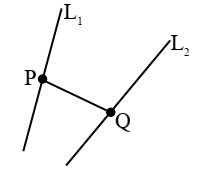
General point on $L_1$: $P(2\lambda+1, 3\lambda+2, 4\lambda+3)$.
General point on $L_2$: $Q(3\mu+2, 4\mu+4, 5\mu+5)$.
Direction ratios of $PQ$: $\langle 3\mu-2\lambda+1, 4\mu-3\lambda+2, 5\mu-4\lambda+2 \rangle$.
Since $PQ$ is the line of shortest distance, it is perpendicular to both $L_1$ and $L_2$.
$$ \vec{PQ} \cdot \vec{d_1} = 0 \Rightarrow 2(3\mu-2\lambda+1) + 3(4\mu-3\lambda+2) + 4(5\mu-4\lambda+2) = 0 $$
$$ \Rightarrow 38\mu – 29\lambda + 16 = 0 \quad \dots(1) $$
$$ \vec{PQ} \cdot \vec{d_2} = 0 \Rightarrow 3(3\mu-2\lambda+1) + 4(4\mu-3\lambda+2) + 5(5\mu-4\lambda+2) = 0 $$
$$ \Rightarrow 50\mu – 38\lambda + 21 = 0 \quad \dots(2) $$
Solving (1) and (2), we get $\lambda = \frac{1}{3}$ and $\mu = -\frac{1}{6}$.
Substituting values, we get coordinates:
$$ P\left(\frac{5}{3}, 3, \frac{13}{3}\right) \quad \text{and} \quad Q\left(\frac{3}{2}, \frac{10}{3}, \frac{25}{6}\right) $$
Equation of line $PQ$ (using points P and Q):
$$ \frac{x – 5/3}{1} = \frac{y – 3}{-2} = \frac{z – 13/3}{1} $$
Checking option (4) $(\frac{14}{3}, -3, \frac{22}{3})$:
$$ \frac{14/3 – 5/3}{1} = 3, \quad \frac{-3 – 3}{-2} = 3, \quad \frac{22/3 – 13/3}{1} = 3 $$
Since all ratios are equal, point (4) lies on the line.
Ans. (4)