Question ID: #1157
If the four distinct points $(4, 6)$, $(-1,5)$, $(0,0)$ and $(k, 3k)$ lie on a circle of radius $r$, then $10k+r^{2}$ is equal to
- (1) 32
- (2) 33
- (3) 34
- (4) 35
Solution:
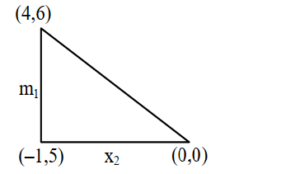
$$m = \frac{y_2 – y_1}{x_2 – x_1}$$
$$m_1 = \frac{5 – 0}{-1 – 0} = -5$$
$$m_2 = \frac{6 – 5}{4 – (-1)} = \frac{1}{5}$$
$$m_1 \times m_2 = -5 \times \frac{1}{5} = -1$$
$$(x – x_1)(x – x_2) + (y – y_1)(y – y_2) = 0$$
$$(x – 0)(x – 4) + (y – 0)(y – 6) = 0$$
$$x^2 + y^2 – 4x – 6y = 0$$
$$k^2 + (3k)^2 – 4k – 6(3k) = 0$$
$$10k^2 – 22k = 0$$
$$k = \frac{11}{5}$$
$$r = \frac{1}{2} \sqrt{(x_2 – x_1)^2 + (y_2 – y_1)^2}$$
$$r = \frac{1}{2} \sqrt{(4 – 0)^2 + (6 – 0)^2} = \frac{1}{2} \sqrt{52} = \sqrt{13}$$
$$r^2 = 13$$
$$10k + r^2 = 10 \left(\frac{11}{5}\right) + 13$$
$$22 + 13 = 35$$
Ans. (4)
Was this solution helpful?
YesNo