The radius of the smallest circle which touches the parabolas $y=x^{2}+2$ and $x=y^{2}+2$ is
- (1) $\frac{7\sqrt{2}}{2}$
- (2) $\frac{7\sqrt{2}}{16}$
- (3) $\frac{7\sqrt{2}}{4}$
- (4) $\frac{7\sqrt{2}}{8}$
Solution:
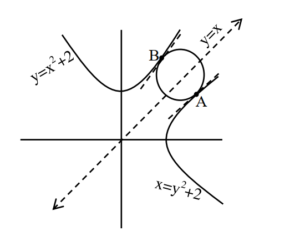
The given parabolas $y=x^{2}+2$ and $x=y^{2}+2$ are inverse functions of each other and are symmetric about the line $y=x$.
For the smallest circle touching both parabolas, the points of contact $A$ and $B$ will be the points of closest approach. The tangents at these points will be parallel to the line of symmetry, $y=x$.
Slope of the tangent, $m = 1$.
For the parabola $y=x^{2}+2$:
$$\frac{dy}{dx} = 2x$$
$$2x = 1 \Rightarrow x = \frac{1}{2}$$
$$y = \left(\frac{1}{2}\right)^{2} + 2 = \frac{1}{4} + 2 = \frac{9}{4}$$
Point $B$ on the first parabola is $\left(\frac{1}{2}, \frac{9}{4}\right)$.
By symmetry about the line $y=x$, the corresponding point $A$ on the second parabola $x=y^{2}+2$ is:
$$A = \left(\frac{9}{4}, \frac{1}{2}\right)$$
The distance $AB$ is the diameter of the required smallest circle.
$$d = \sqrt{(x_2 – x_1)^2 + (y_2 – y_1)^2}$$
$$AB = \sqrt{\left(\frac{1}{2} – \frac{9}{4}\right)^{2} + \left(\frac{9}{4} – \frac{1}{2}\right)^{2}}$$
$$AB = \sqrt{\left(-\frac{7}{4}\right)^{2} + \left(\frac{7}{4}\right)^{2}}$$
$$AB = \sqrt{\frac{49}{16} + \frac{49}{16}}$$
$$AB = \sqrt{\frac{98}{16}} = \frac{7\sqrt{2}}{4}$$
$$\text{Radius} = \frac{AB}{2}$$
$$\text{Radius} = \frac{1}{2} \cdot \frac{7\sqrt{2}}{4} = \frac{7\sqrt{2}}{8}$$
Ans. (4)