A line passes through the origin and makes equal angles with the positive coordinate axes. It intersects the lines $L_{1}: 2x+y+6=0$ and $L_{2}: 4x+2y-p=0$, $p>0$, at the points $A$ and $B$, respectively.If $AB=\frac{9}{\sqrt{2}}$ and the foot of the perpendicular from the point $A$ on the line $L_{2}$ is $M$, then $\frac{AM}{BM}$ is equal to
- (1) 5
- (2) 4
- (3) 2
- (4) 3
Solution:
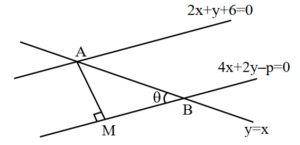
The line passing through the origin and making equal angles with the positive axes is $y = x$.
]$$m_1 = 1$$
The given lines are $L_1: 2x+y+6=0$ and $L_2: 4x+2y-p=0$.
Slope of the parallel lines $L_1$ and $L_2$ is:
$$m_2 = -2$$
Let $\theta$ be the angle between the transversal line $AB$ and $L_2$.
$$\tan \theta = \left| \frac{m_1 – m_2}{1 + m_1 m_2} \right|$$
$$\tan \theta = \left| \frac{1 – (-2)}{1 + (1)(-2)} \right|$$
$$\tan \theta = \left| \frac{3}{-1} \right| = 3$$
In right-angled $\triangle AMB$, the angle at $M$ is $90^\circ$ and $\angle ABM = \theta$.
$$\tan \theta = \frac{AM}{BM}$$
$$\frac{AM}{BM} = 3$$
Ans. (4)